Full Specimen Plate
Anthurium bonplandii
Bonpland's Bird's Nest Anthurium
- Premium New Zealand Sphagnum Moss, 100gLong-fibre sphagnum for air-layering, top-dressing, and epiphyte substrate mixes.
- Natural Rooting Powder, 3 x 75gRooting hormone powder for stem and leaf cuttings.
- Precision Bonsai Pruning Scissors, 200mmFine-bladed snips for clean node cuts when taking a cutting.
- Digital Hygrometer & ThermometerLCD humidity and temperature gauge for checking a grow spot against a plant's target range.
Amazon links — we may earn commission on qualifying purchases.
7cm Target Price
£28.00
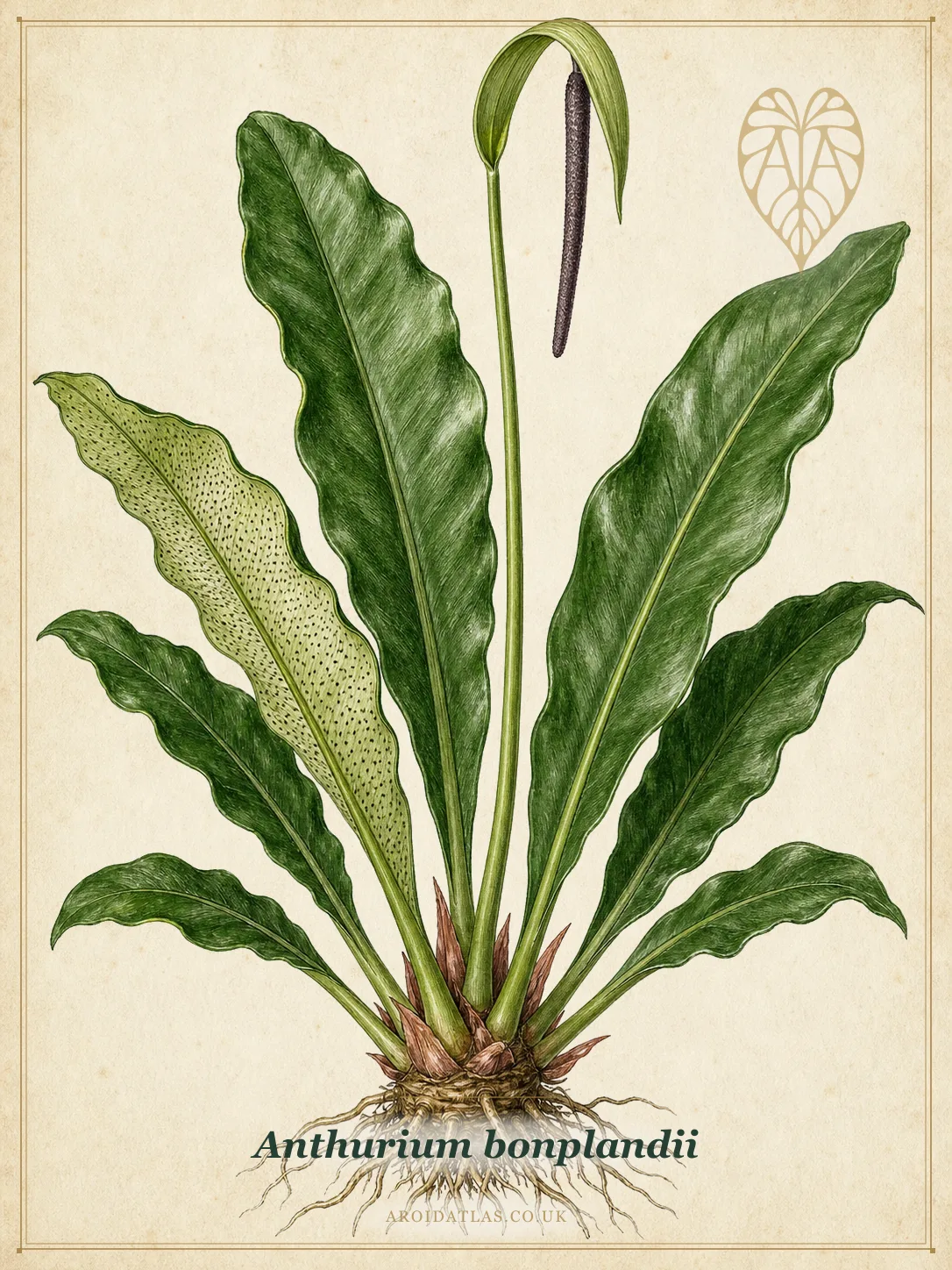
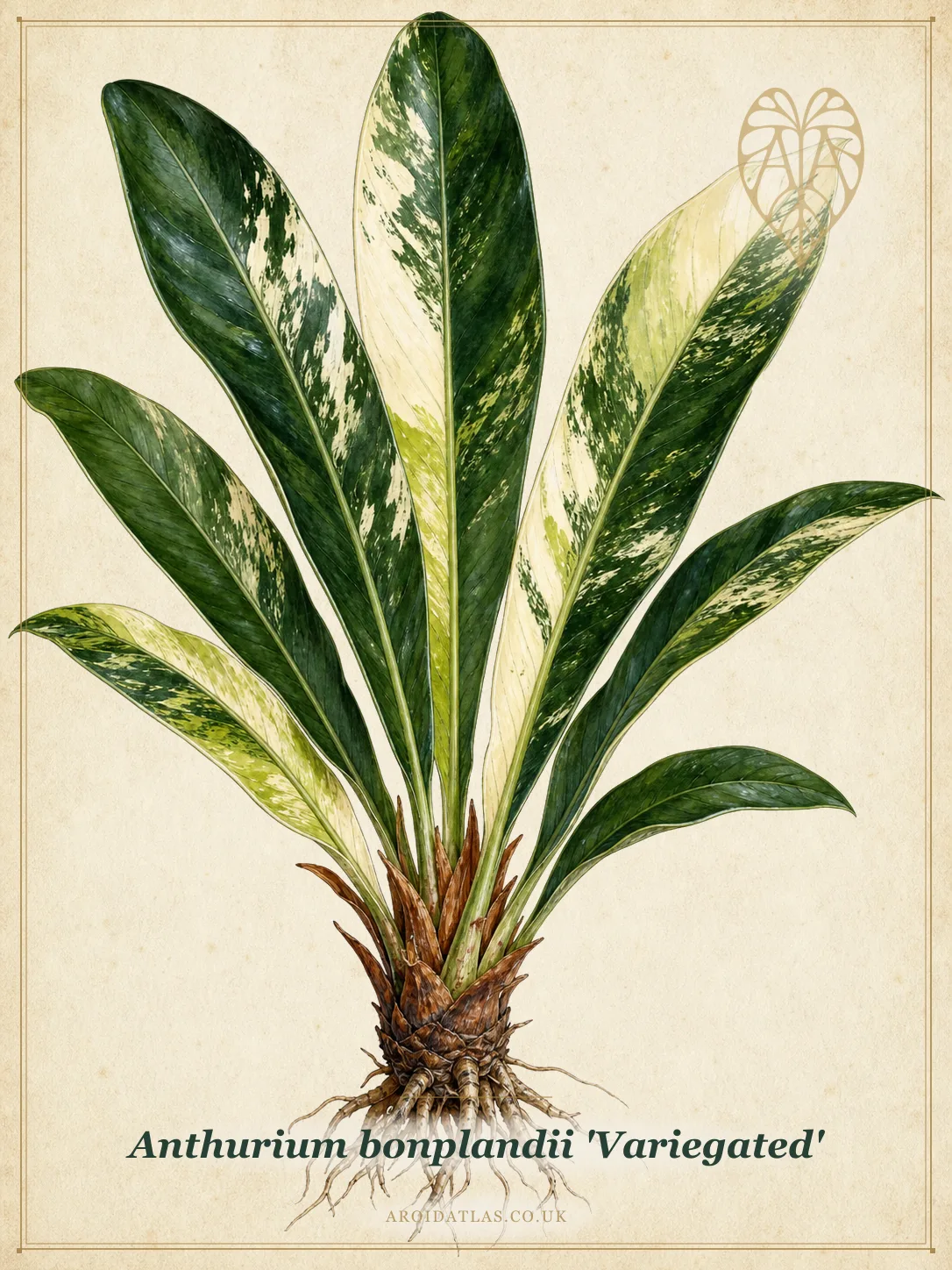
Anthurium bonplandii Morphology
About Anthurium bonplandii
George Bunting described Anthurium bonplandii in 1975, naming it after the botanist Aimé Bonpland. It belongs to section Pachyneurium, the bird's-nest anthuriums, and forms a short-stemmed rosette of thick, erect to arching leaves that collect leaf litter at the centre. Three subspecies are recognised: subsp. bonplandii with elliptic blades, subsp. guayanum from the Guiana Shield with oblanceolate to obovate blades, and subsp. cuatrecasasii from southeastern Colombia and western Venezuela. The most reliable field character is the dense scatter of dark glandular dots on the leaf underside, which separates it from A. jenmanii, the name it is most often sold under.
Native Range
Colombia
Market Hub
Anthurium bonplandii Sold Prices & Live Market
What the Target Price above is based on: eBay sold prices by plant size, live listings, and retailer stock.
No eBay sales recorded yet. Sold listings are collected as they appear on eBay.
Before You Buy
Species-specific things to check when evaluating a listing
- Turn a leaf over and look for dark glandular dots on the underside; true jenmanii lacks them
- Ask the seller whether the plant is subsp. guayanum or subsp. bonplandii; leaf outline (obovate vs elliptic) is the quick check
- Check the crown for soft or dark tissue, a sign of rot from water sitting in the rosette
- Seed-grown plants from mixed Pachyneurium collections are often hybrids; buy from a named parent where possible
Propagation Guide
How to Propagate Anthurium bonplandii
Propagation Guide
How to Propagate Anthurium bonplandii
4-8 months
Cultivar character is preserved through vegetative cuttings
Mature rosettes produce basal offsets; separate them once each has three or four roots of its own. Seed sets readily when two plants flower together and germinates on moist sphagnum within a few weeks.
Care Guide
Anthurium bonplandii Care Guide & Growing Conditions
Care Guide
Anthurium bonplandii Care Guide & Growing Conditions
Chunky, free-draining mix: orchid bark, perlite, coarse coir chips and a little horticultural charcoal. The thick roots rot in dense compost.
Water thoroughly once the top third of the pot has dried. Tip out water that pools in the leaf rosette during winter.
Tolerates average room humidity better than velvet-leaved anthuriums; 55% or more keeps new leaves from tearing as they unroll.
Balanced fertiliser at half strength every four weeks from spring to early autumn.
Every two to three years into a pot only slightly wider than the root mass; keep the crown at the same level.
Common Problems
Brown, split leaf edges on new growth
Low humidity while the leaf is unrolling
Raise humidity above 55% during active growth
Crown rot
Water sitting in the rosette centre in cool conditions
Water at the substrate, not over the crown, and keep above 15°C
Scale insects on leaf undersides
Common on thick-leaved bird's-nest anthuriums
Wipe off with isopropyl alcohol and treat with a systemic insecticide if they return
Field Reference
In the Wild
Field Reference
In the Wild
Field Notes
Field Notes: Litter Baskets on Guiana Sandstone
Subsp. guayanum grows on sandstone outcrops, boulders and white-sand soils across Bolívar State in Venezuela, Guyana, Suriname and northern Brazil, mostly between 400 and 1,500 m. Soils there are thin and nutrient-poor. The upright rosette funnels falling leaves and water to the centre, where the litter breaks down among the roots, a strategy shared with other section Pachyneurium species. The pendent spadix turns reddish to purple-brown at anthesis, and the green spathe reflexes back soon after opening. Ripe berries are reddish purple and obovoid.