Propagating Anthurium
Anthurium's fine, velamen-coated roots don't behave like a vining aroid's; division is the reliable method, and the aftercare has to respect roots that hate sitting wet.
Roots built for bark, not soil
Most collectible Anthurium are epiphytic or hemiepiphytic in habitat, growing on tree bark and in canopy leaf litter rather than in soil. Their roots are coated in velamen, a spongy, absorbent outer layer adapted to wick moisture from humid air and loose organic debris rather than sit submerged in it. That's why Anthurium roots are noticeably more prone to rot in a constantly wet substrate than the thicker, more waterlogging-tolerant roots of a Monstera or Philodendron.
That anatomy is exactly why propagation technique differs from the climbing-aroid method even though both are Araceae: division, not water rooting, is the default, and the aftercare leans on humidity rather than a wet medium.
Step by Step
Follow the trail below, one component at a time — each illustrated in the same antique botanical plate style used across our species archive.
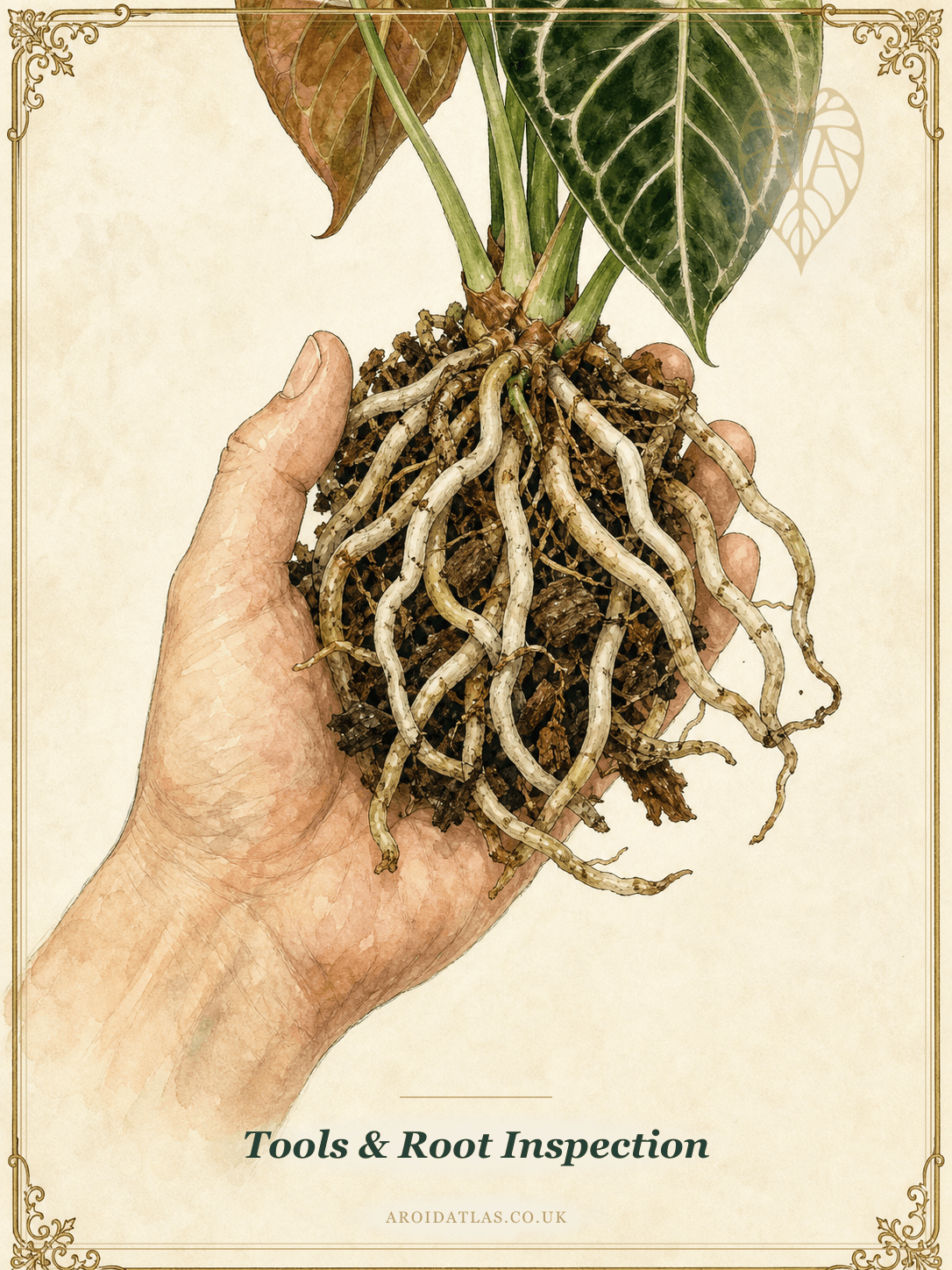
Tools & Root Inspection
Unpot the plant and gently tease the root mass apart enough to see its structure before deciding where to divide. Healthy Anthurium roots are typically thick, pale, and slightly spongy to the touch from their velamen coating. Brown, mushy sections should be trimmed away with a sterilized blade before you go any further.
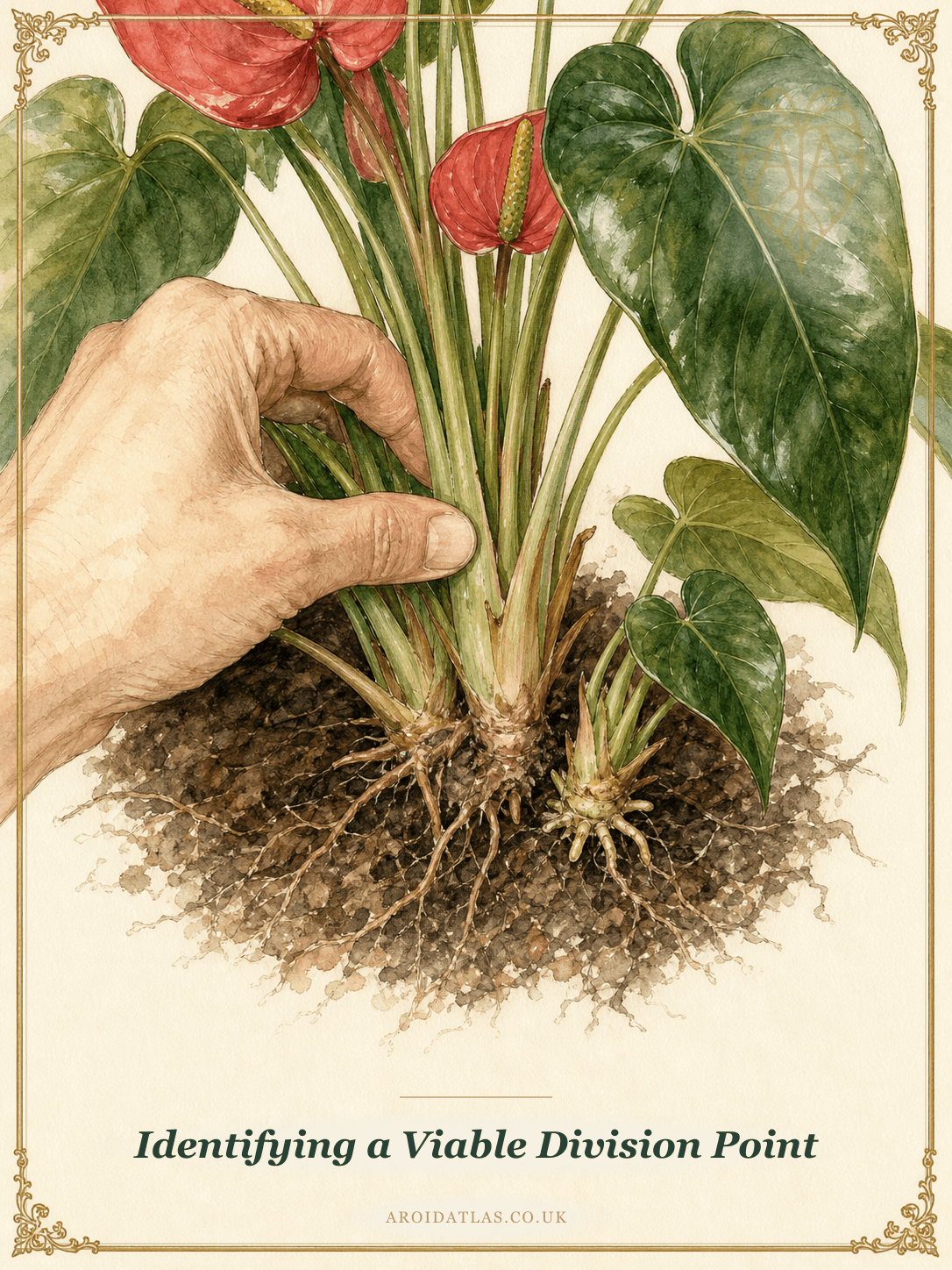
Identifying a Viable Division Point
Look for a basal offset or secondary growth point that already has its own roots attached, distinct from the plant's main crown. A shared crown with no independent root system of its own isn't ready to divide yet; forcing a split there just damages the parent for a piece that likely won't establish.
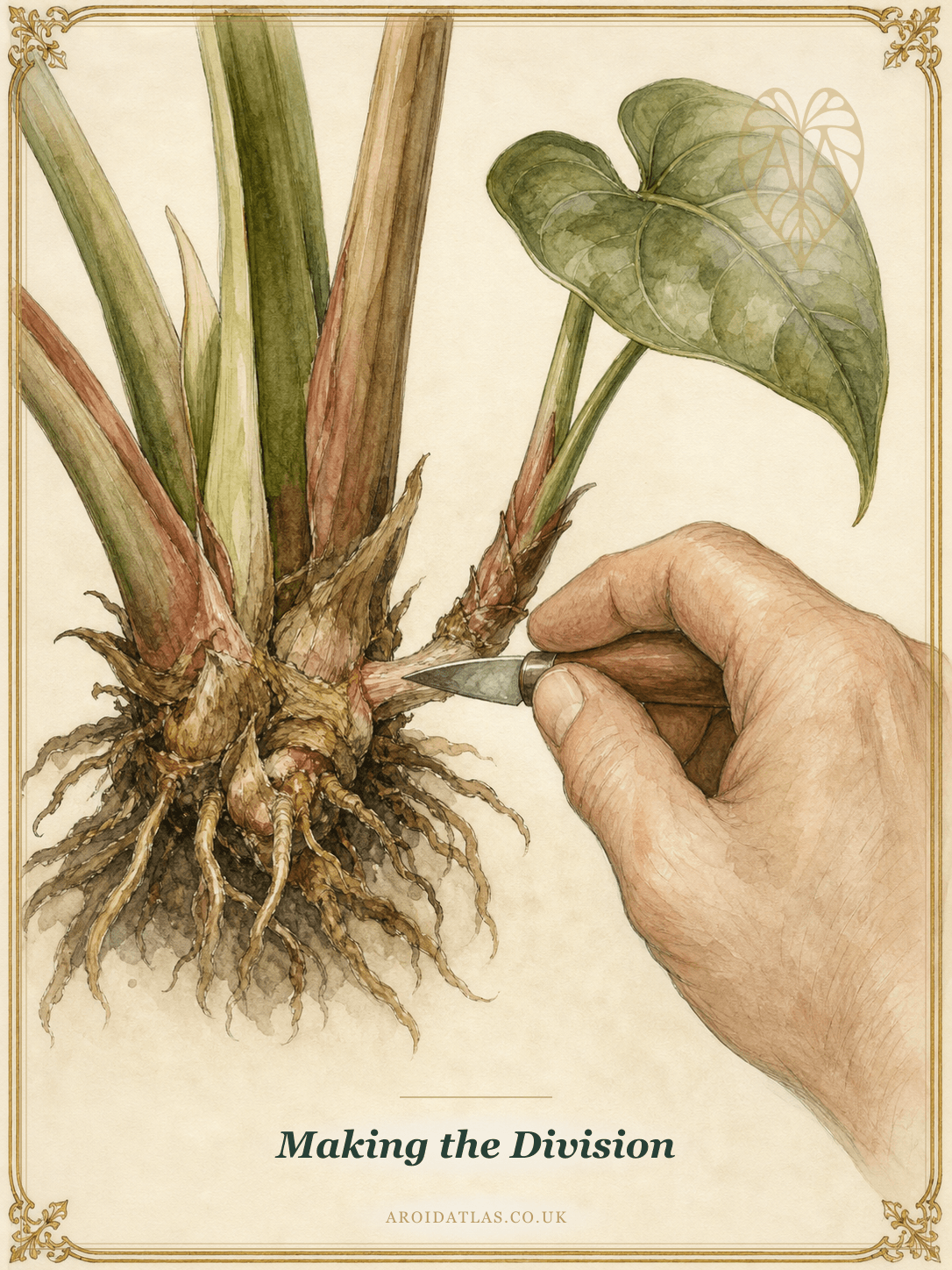
Making the Division
Cut cleanly through the connecting tissue with a sterilized blade, keeping the offset's own roots intact. For vining types like Anthurium scandens, take a node cutting instead: the same 1cm-below-the-node cut used for climbing aroids applies here rather than a basal split.
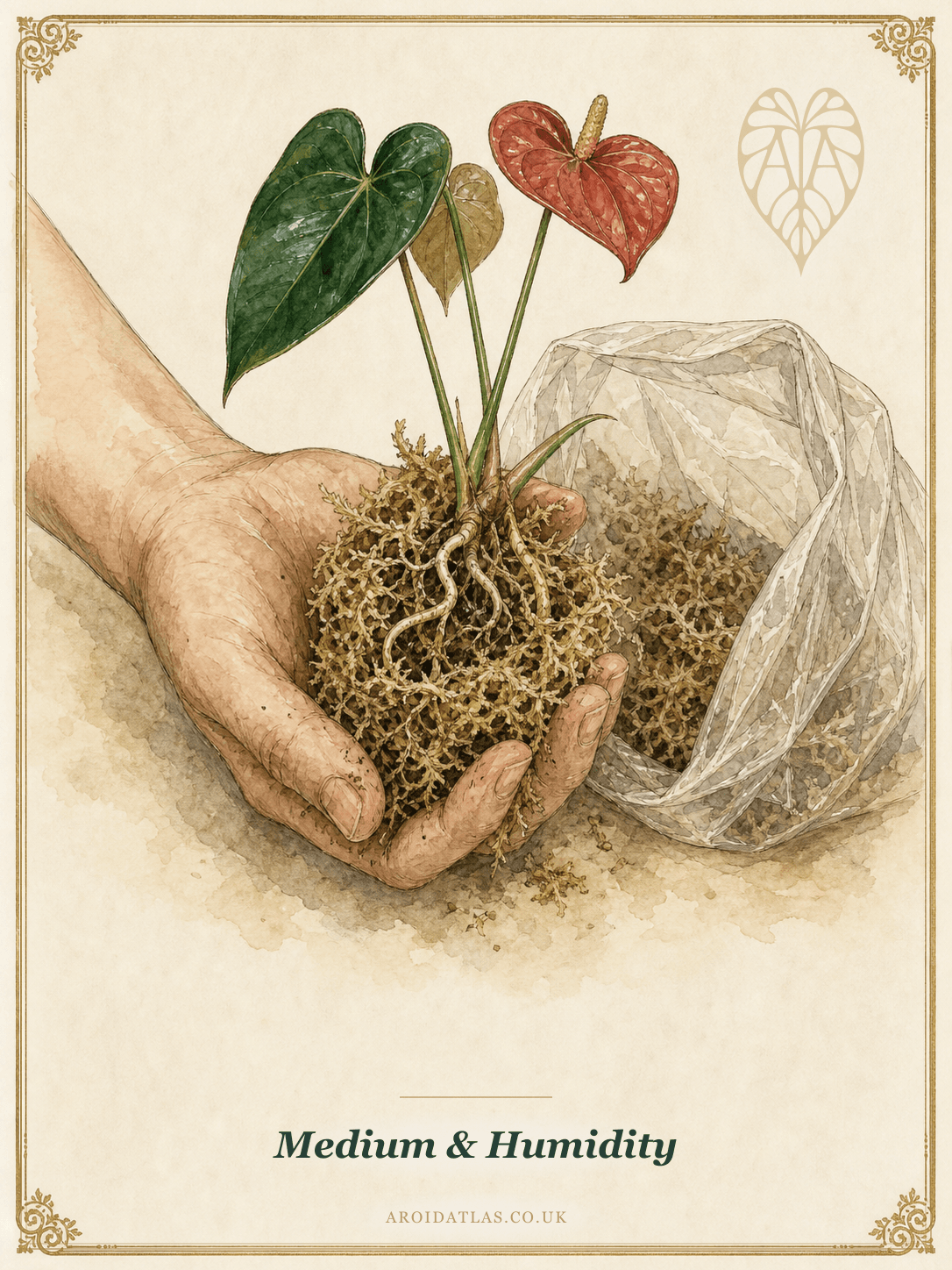
Medium & Humidity
Sphagnum moss, kept damp rather than wet, suits Anthurium's fine roots far better than water propagation; prolonged submersion is exactly the condition their velamen-coated roots are least adapted to tolerate. A sealed bag or humidity dome around the potted division keeps ambient moisture high without needing the medium itself to stay saturated.
Keep the humidity setup somewhere still and warm rather than under a fan, since Anthurium's thinner-rooted divisions dry out faster under direct airflow than a climbing aroid cutting would.
Aftercare & Signs of Success
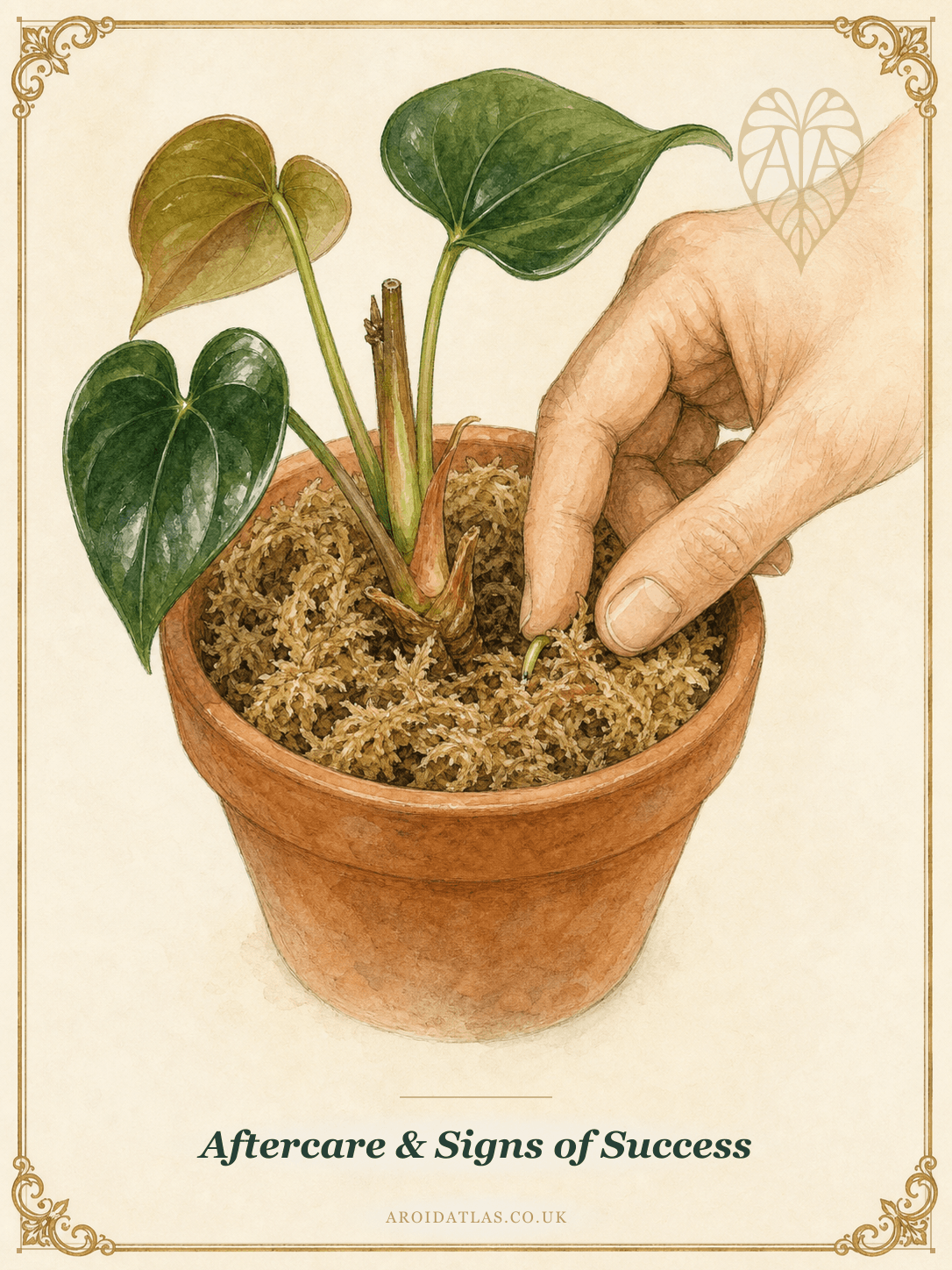
New root tips showing pale green or white growth are the clearest sign a division has taken. Resist the urge to dig around and check progress in the meantime. Disturbing a division to inspect it is one of the most common ways to snap the fragile new roots it's only just started growing.
The vining exception
Not every Anthurium grows as a solitary, crown-forming rosette. Vining and scrambling types with elongated internodes (Anthurium scandens is the most commonly grown example) climb and root at nodes along the stem in a way that's genuinely closer to a Philodendron than to a rosette-forming Anthurium like A. warocqueanum. For these vining types, a node cutting works the same way it would on a climbing aroid, rather than requiring a full basal division.
"Sphag and bag", precisely
Wrap the division in sphagnum moss wrung out until barely damp, not dripping, then seal it in a clear bag. Crack the bag open for a few minutes once a day to exchange stale air; the exact ratio and routine gets repeated constantly across Anthurium-collector circles because it reliably avoids both the bone-dry and waterlogged extremes.
Still air over moving air
A gentle circulation fan is good practice for a humid grow space in general, but a fresh Anthurium division does better somewhere warm and still while it's callusing. Direct airflow that a climbing-aroid cutting would tolerate fine can dry out Anthurium's thinner root tissue faster than it can recover from.
Seed propagation is a breeder's project, not a shortcut
Anthurium can be grown from seed after hand-pollinating the spadix and waiting months for berries to ripen, but it's a slow route aimed at producing new genetics, not a faster or easier way to multiply a plant you already own; open pollination doesn't reliably reproduce the parent's traits, and it's typically six to twelve months before a seedling is even worth potting on its own.
Root colour tells you more than time does
Don't count days and assume a division is ready: check for pale green or white new root tips instead. A division can sit for weeks doing nothing visible above the medium while it's quietly building the root mass that determines whether it survives being potted up.