Scroll to explore forms of Anthurium pallidiflorum
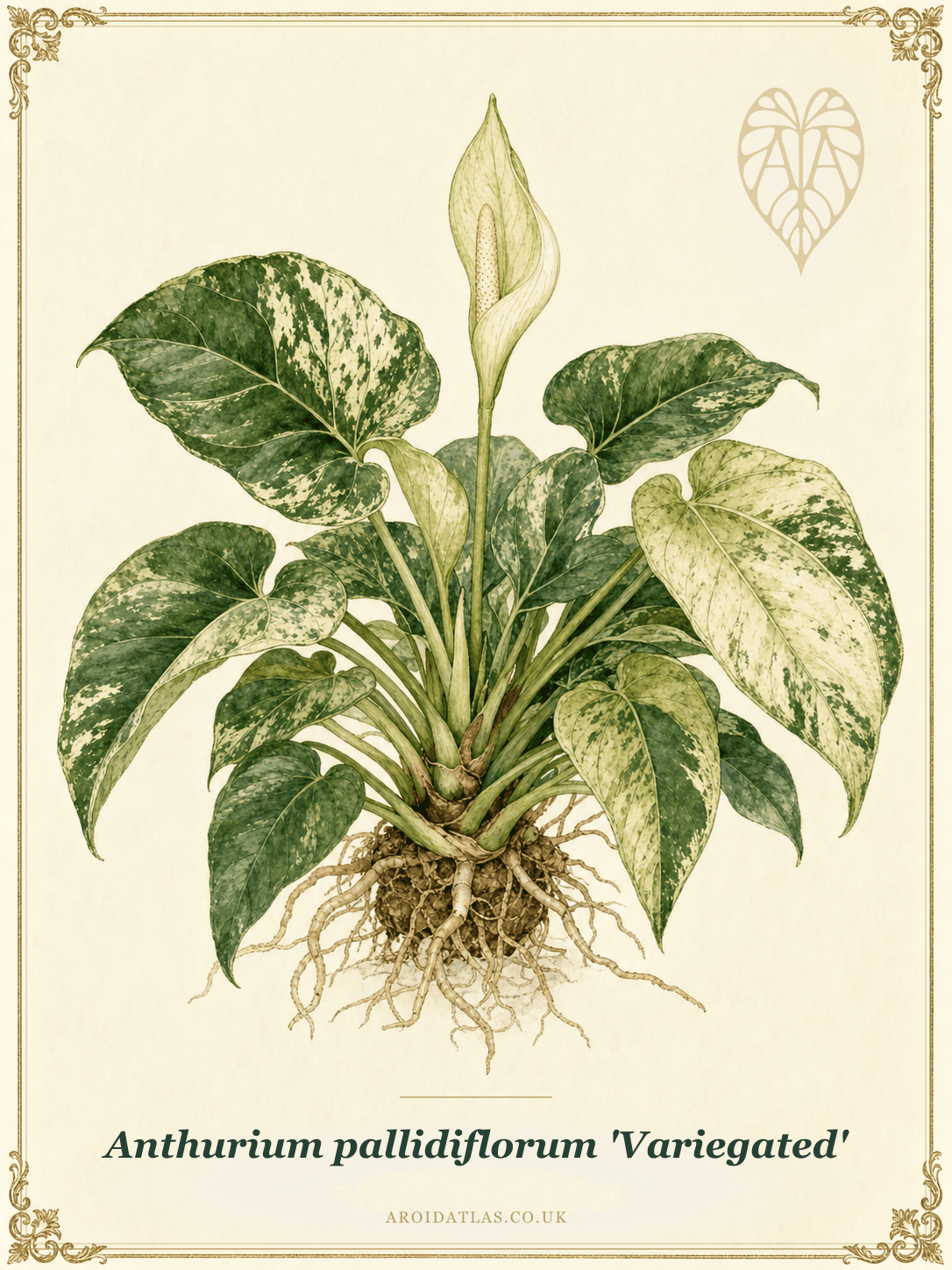
Full Specimen Plate
Anthurium pallidiflorum
Strapleaf Anthurium
Aroid Atlas Price Guide
Select Plant Size
Pricing Data Key
Community price estimate based on limited sales history
Other colour-form prices
Market Analysis
Anthurium pallidiflorum Price Guide & Auction Value
Historical eBay auction metrics and live retailer listings updated weekly.
No eBay auction history available yet. Data is collected automatically as sales appear on eBay UK.
Before You Buy
Species-specific things to check when evaluating a listing
- Count the healthy leaves — strap-leaf anthuriums grow very slowly, so buying a plant with only one leaf means a long wait before it becomes an attractive specimen
- Check for scale insects along the underside midrib of leaves — they are small, brown, and flat and easy to miss
- Roots should be firm — check that drainage holes are visible in listing photos; root rot from waterlogged shipping medium is common
- Ask the seller how many roots the plant has — a well-rooted plant establishes far faster than a recently divided offset
Anthurium pallidiflorum Morphology
About Anthurium pallidiflorum
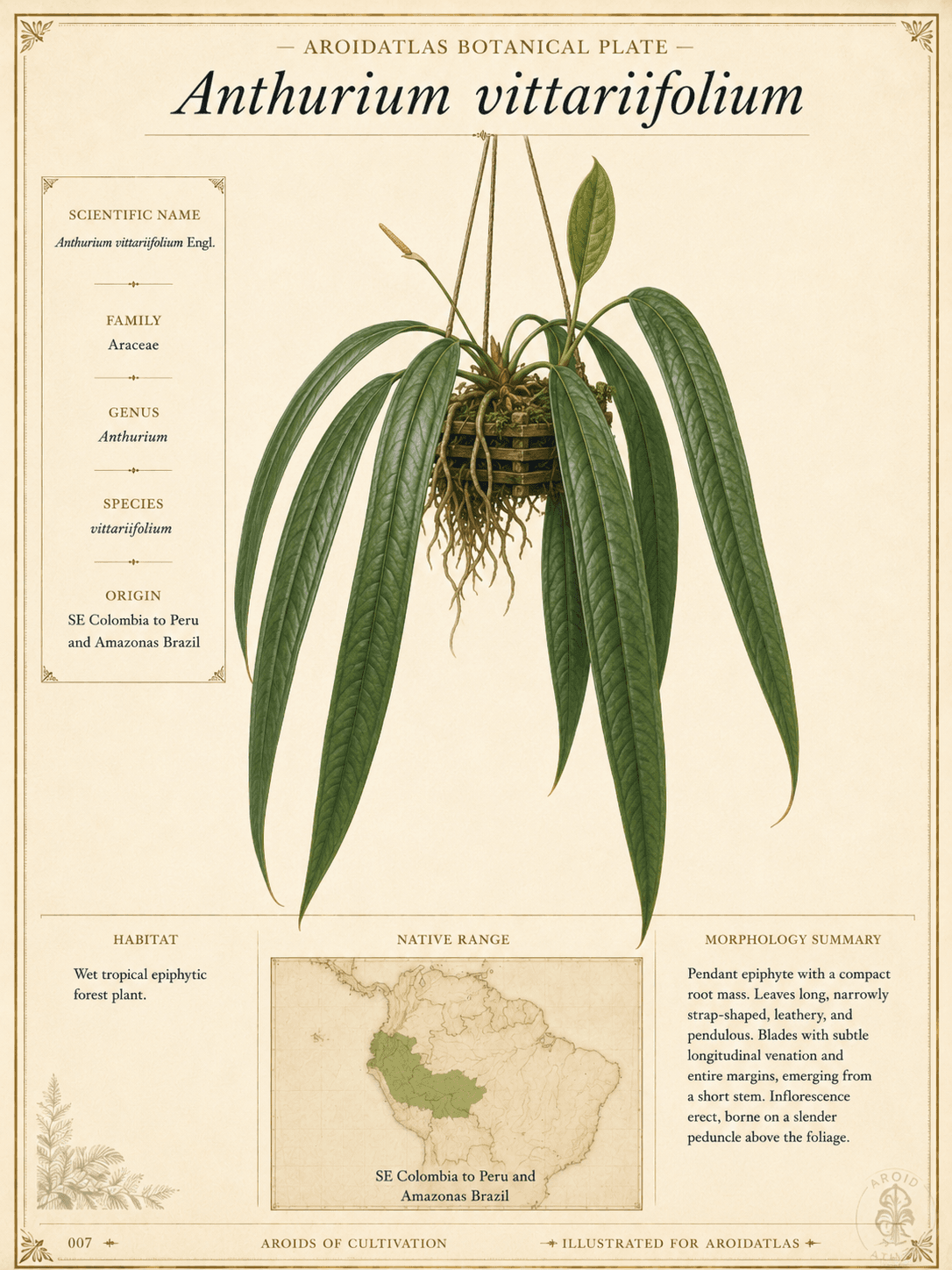
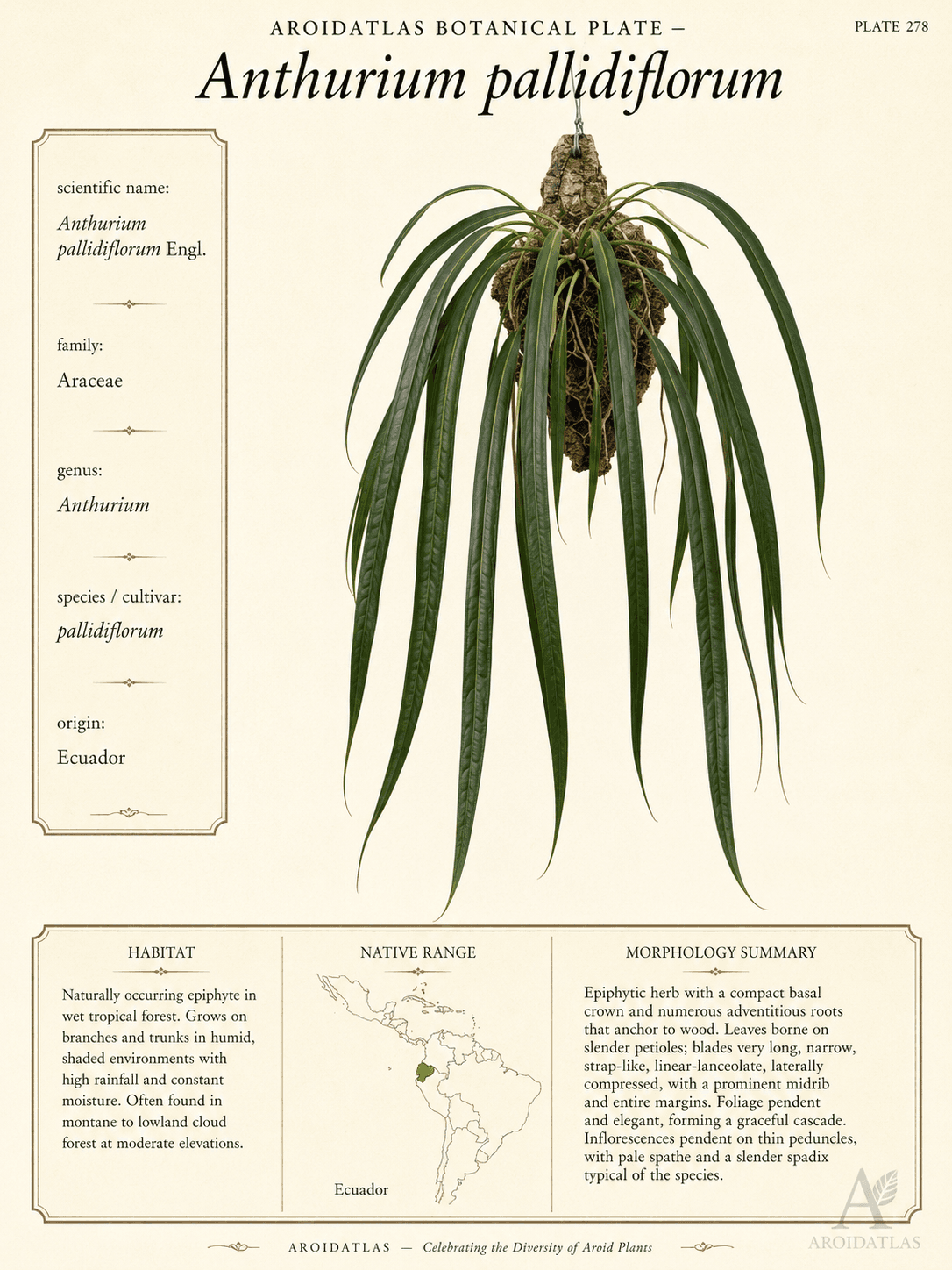
Anthurium pallidiflorum is an epiphytic herb native to Ecuador, thriving in wet tropical forests. It typically anchors itself to branches and trunks in humid, shaded environments with high rainfall and constant moisture, often found in montane to lowland cloud forests at moderate elevations. The plant develops a compact basal crown with numerous adventitious roots that anchor firmly to wood. Its distinctive foliage features very long, narrow, strap-like, linear-lanceolate leaves, borne on slender petioles. These leaves are laterally compressed with a prominent midrib and entire margins, forming an elegant, pendent cascade.
Native Range
Ecuador
Propagation Guide
How to Propagate Anthurium pallidiflorum
Strap-leaf anthuriums rarely branch and are slow to produce offshoots. Stem cuttings require high humidity and warmth. Success rates are lower than velvet types.
Care Guide
Anthurium pallidiflorum Care Guide & Growing Conditions
Very coarse epiphytic mix: 50% orchid bark, 30% perlite, 20% sphagnum moss. Can also be grown mounted on cork bark for best airflow.
Allow to approach dryness between waterings — strap-leaf anthuriums are more drought-tolerant than velvet types. Water thoroughly, then allow to drain completely.
65–80%. More tolerant of lower humidity than velvet types but still benefit from consistent moisture in the air.
Half-strength orchid fertiliser monthly during growing season. These are slow growers — overfeeding can burn roots.
Infrequently — every 2–3 years. These species often bloom better when slightly root-bound. Consider mounting on cork board instead.
Common Problems
Root rot
Dense substrate or overwatering
Switch to a very coarse bark-heavy mix; allow to dry more between waterings
No new growth
Too cold or too dark
Ensure minimum 18°C and bright indirect light
Brown leaf tips
Low humidity or salt buildup from fertiliser
Flush substrate with clean water to remove salt buildup; increase humidity
A Cloud Forest Cascade
One often yearns for the incessant humidity of an Ecuadorian cloud forest when faced with a particularly damp British summer. *Anthurium pallidiflorum*, the Strapleaf Anthurium, always brings me back. Described by Engler in 1898, this epiphytic marvel clings to branches in its native montane forests, thriving in constant moisture and shade. Its compact basal crown gives rise to these wonderfully long, narrow, strap-like, linear-lanceolate leaves – quite the elegant, pendent cascade, isn't it? The smooth, leathery texture and prominent midrib are defining features. No variegation, thankfully, meaning one can appreciate its rather unique form without distraction. A fascinating adaptation to life high above the forest floor, though perhaps a tad challenging to accomodate in a modest glasshouse.