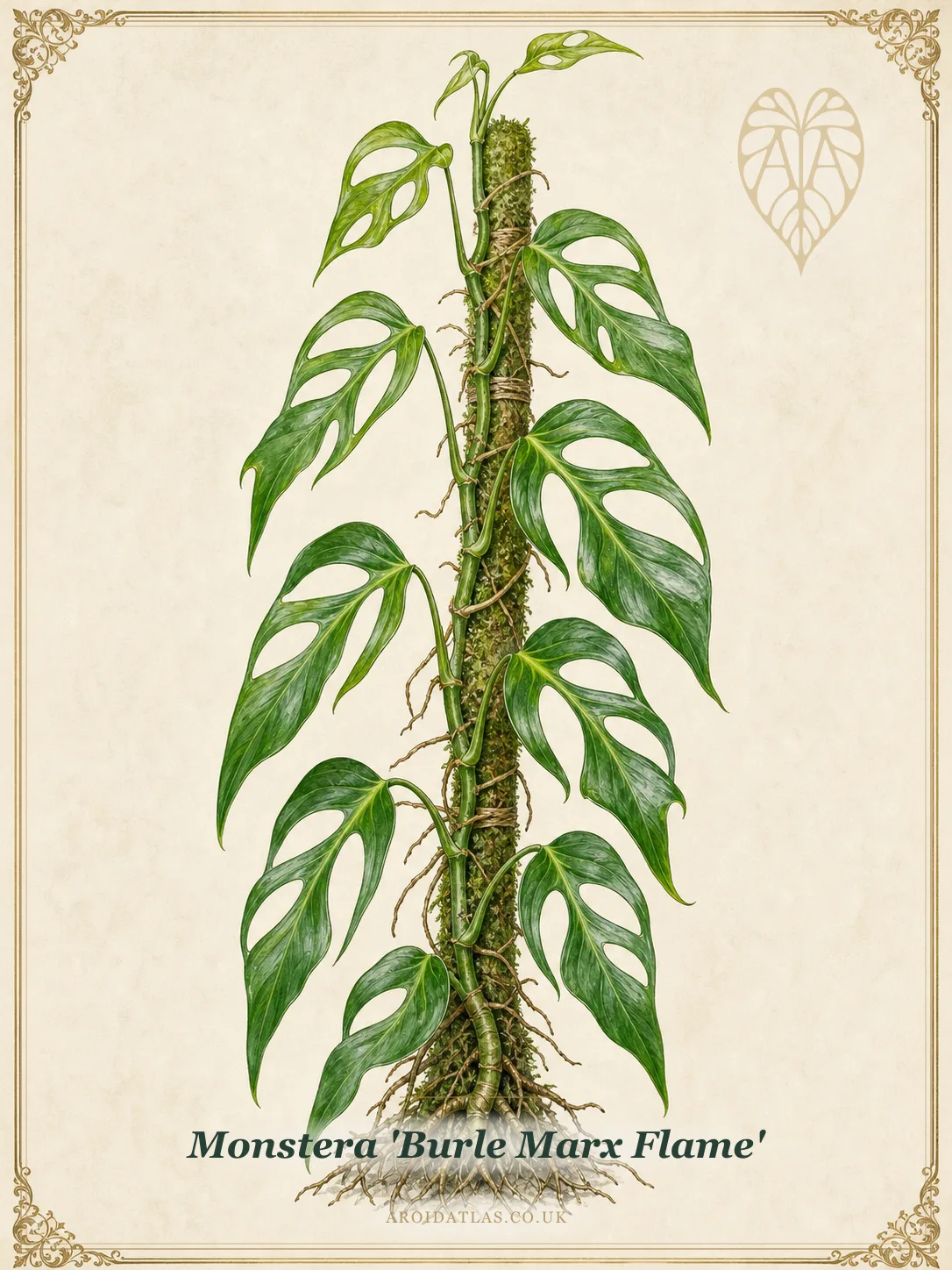
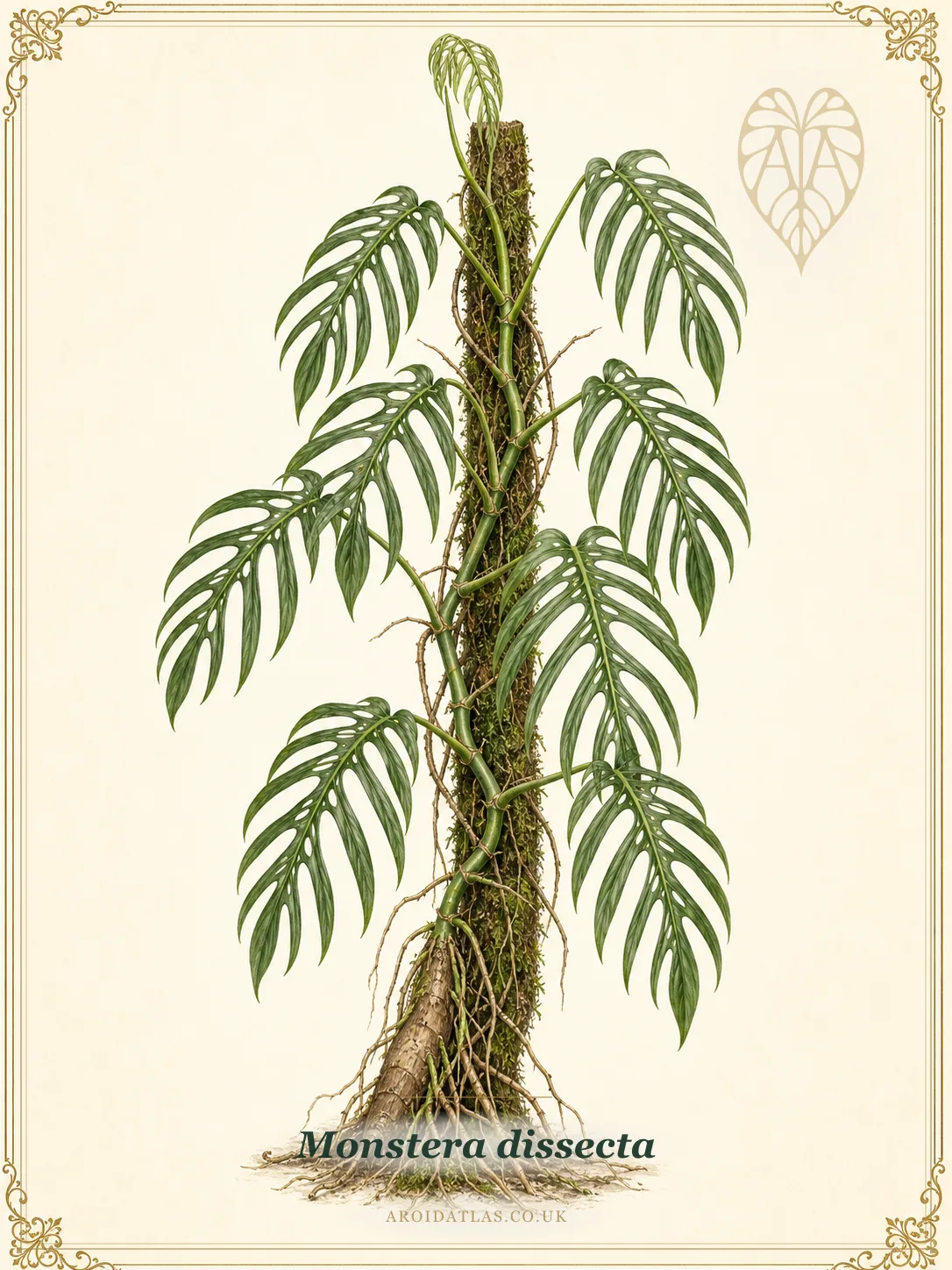
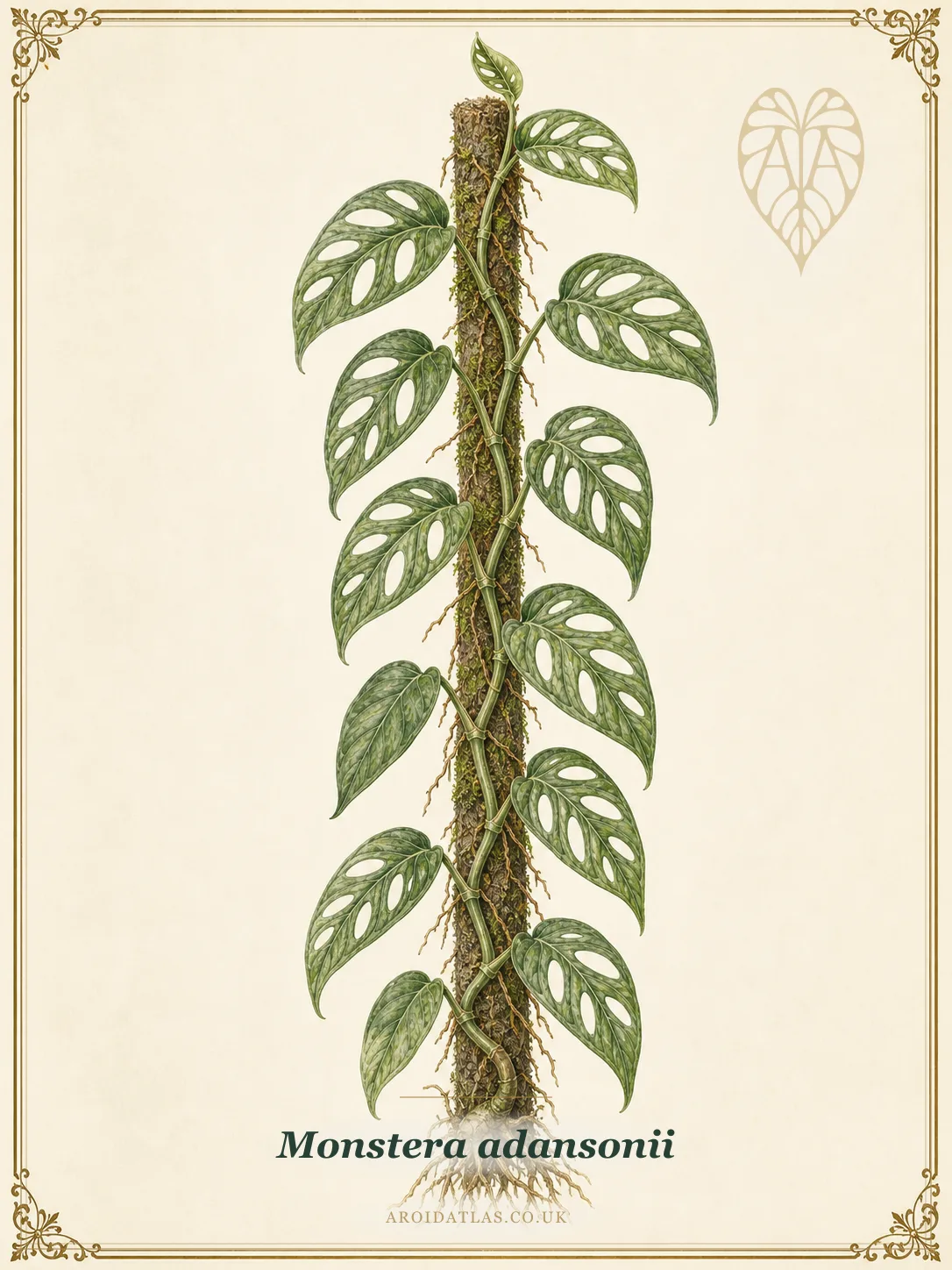
Full Specimen Plate
Monstera gracilis
Slender Monstera
- Coir Moss Pole, 120cm (4-Pack)Coco coir totem for climbing aroids to root into as they grow upward.
- Natural Rooting Powder, 3 x 75gRooting hormone powder for stem and leaf cuttings.
- Precision Bonsai Pruning Scissors, 200mmFine-bladed snips for clean node cuts when taking a cutting.
- Digital Hygrometer & ThermometerLCD humidity and temperature gauge for checking a grow spot against a plant's target range.
Amazon links — we may earn commission on qualifying purchases.
7cm Target Price
£8.00
Monstera gracilis Morphology
About Monstera gracilis
Monstera gracilis is a climbing aroid native to southern Central America and Colombia, grown attached to a mossy support the way deliciosa or adansonii are. Its leaves are narrower and more finely divided than either of those better-known relatives, with long radiating lobes and elongated fenestration slits that stay mostly closed rather than opening into round holes, giving it a family resemblance to Burle Marx Flame without that plant's broader, bolder segments. The trade name is more established than a settled taxonomic placement; specialty sellers list it as M. gracilis, but plants under that label are not always a confirmed match to the species as formally described. Availability is limited to specialty tropical plant sellers rather than general retail.
Native Range
Colombia
Market Hub
Monstera gracilis Sold Prices & Live Market
What the Target Price above is based on: eBay sold prices by plant size, live listings, and retailer stock.
No eBay sales recorded yet. Sold listings are collected as they appear on eBay.
Before You Buy
Species-specific things to check when evaluating a listing
- Confirm the listing photo shows the narrow, finely divided lobing typical of gracilis rather than a mislabelled Burle Marx Flame or dissecta, both easily confused with this species in trade listings
- Ensure at least one healthy node is present; a cutting without a node cannot produce new growth
- Check the trade name against seller reputation. Identity in this species rests on established trade convention more than confirmed botanical verification
- Inspect leaf undersides and petiole junctions for scale and mealybugs before buying
Propagation Guide
How to Propagate Monstera gracilis
Propagation Guide
How to Propagate Monstera gracilis
3-6 months
Cultivar character is preserved through vegetative cuttings
Care Guide
Monstera gracilis Care Guide & Growing Conditions
Care Guide
Monstera gracilis Care Guide & Growing Conditions
Chunky, well-draining aroid mix: 40% potting compost, 30% perlite, 20% orchid bark, 10% worm castings.
Water when the top 3-4cm of substrate is dry. Standard Monstera watering; more forgiving than most aroids but still susceptible to root rot kept constantly wet.
65-80% preferred. Tolerates typical indoor humidity once established, though leaf division and size improve at the higher end.
Balanced liquid fertiliser at half strength every 2-3 weeks in spring and summer. Little to none in winter.
Every 12-18 months, or when roots fill the pot. A moss pole or coir totem is needed for the roots to climb; mature, more deeply divided leaves form on a supported climber, not a trailing one.
Common Problems
Leaves stay narrow and less deeply divided
Juvenile growth, or insufficient light and climbing support
Provide bright indirect light and a mossy support; leaf division increases with age and a climbing habit
Fenestration slits fail to develop
Low light or a young, immature plant
Increase light and allow the plant to mature on a support; the closed slits characteristic of this species develop over several leaf cycles
Leggy stems with long bare internodes
Insufficient light causing the plant to stretch toward a light source
Move to a brighter spot and provide a support for the roots to climb
Field Reference
In the Wild
Field Reference
In the Wild
Field Notes
A Name Ahead of Its Verification
Monstera gracilis is a case worth flagging for anyone buying by species name alone. The formally described M. gracilis Engl. is documented as a small, non-climbing species with thin, sparsely lobed leaves and stolons that root along the forest floor, a plant that doesn't resemble what specialty sellers currently list under that name. Plants sold as gracilis in cultivation are climbers with long, narrow, radiating lobes and mostly closed fenestration slits, closer in general appearance to Burle Marx Flame than to the type description. Whether that's a case of mistaken identity carried through the trade, a broader species concept than the type specimen represents, or simply an unrelated plant that inherited the name is not settled. Buy on the appearance of the actual specimen, not the label.