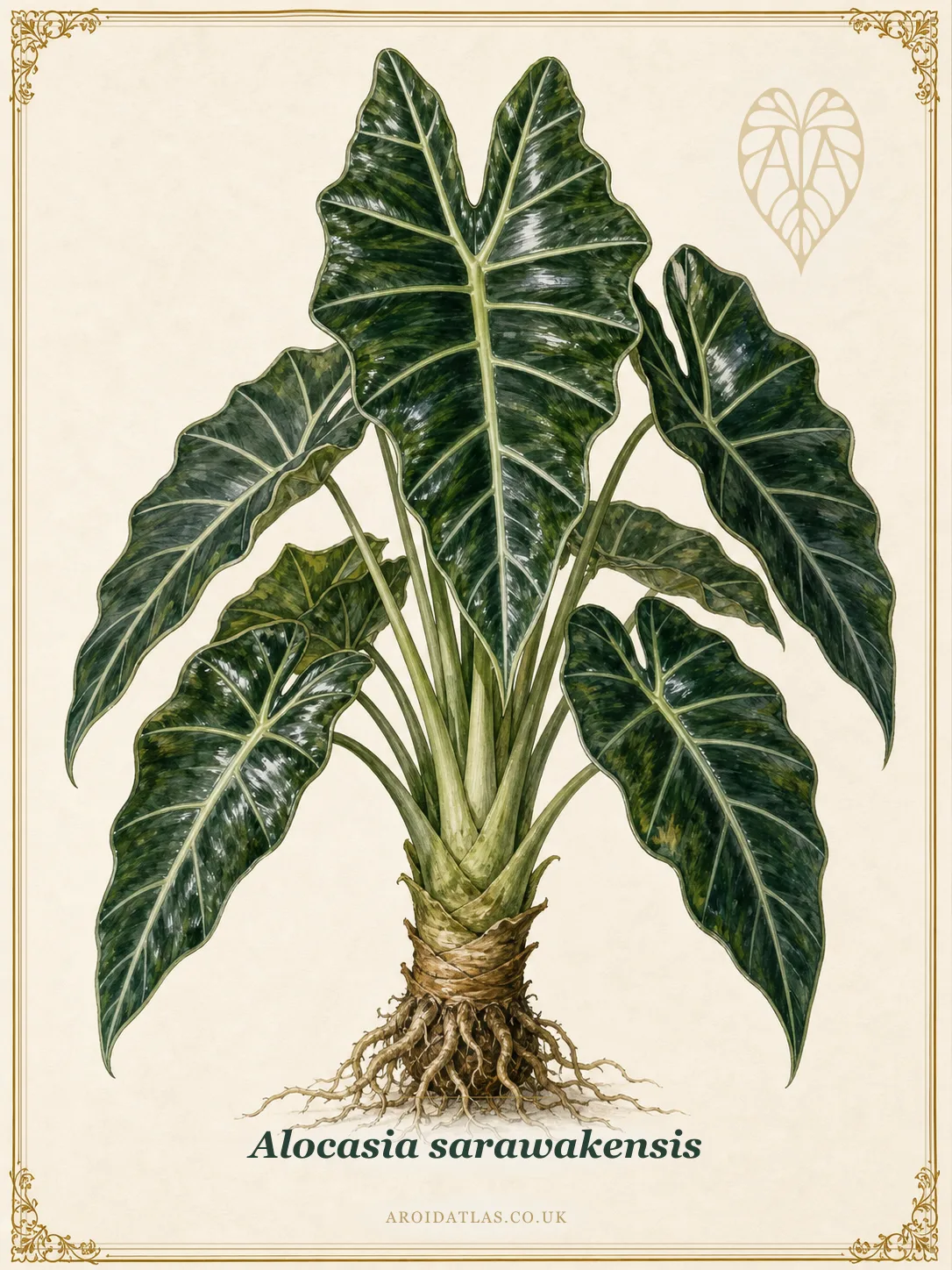
Full Specimen Plate
Alocasia venusta
Boat-Leaf Alocasia
- Flowers of Sulphur, 99.99% PurityDusted onto a fresh corm or rhizome cut to guard against rot before repotting.
- Precision Bonsai Pruning Scissors, 200mmFine-bladed snips for clean node cuts when taking a cutting.
Amazon links — we may earn commission on qualifying purchases.
7cm Target Price
£15.00
Alocasia venusta Morphology
About Alocasia venusta
Alocasia venusta was formally described by Alistair Hay in 1998 from collections near the Niah Caves in northern Sarawak. The species is an obligate lithophyte restricted to limestone karst formations of that region. It is identifiable by narrow lanceolate leaves with a bullate, quilted surface and boat-like undulating margins that curve upward. Because of its lithophytic ecology, potted plants require an alkaline, mineral-heavy potting mix with crushed limestone to prevent corm rot.
Native Range
Sarawak, Malaysian Borneo
Market Hub
Alocasia venusta Sold Prices & Live Market
What the Target Price above is based on: eBay sold prices by plant size, live listings, and retailer stock.
No eBay sales recorded yet. Sold listings are collected as they appear on eBay.
Before You Buy
Species-specific things to check when evaluating a listing
- Check that the plant is grown in an open mineral mix rather than pure nursery peat
- Inspect the narrow leaf margins for intact undulating form without mechanical tears
- Verify the corm is firmly seated in the substrate without wobbling
- Ensure petiole sheaths are free from brown fungal lesions
Propagation Guide
How to Propagate Alocasia venusta
Propagation Guide
How to Propagate Alocasia venusta
10-14 weeks
Cultivar character is preserved through vegetative cuttings
Separate small corms during repotting; root in moist pumice under a humidity dome at 24 C.
Care Guide
Alocasia venusta Care Guide & Growing Conditions
Care Guide
Alocasia venusta Care Guide & Growing Conditions
Gritty mix containing pumice, crushed limestone, volcanic scoria, and coarse perlite with minimal bark
Water thoroughly when the top half of the gritty mix dries; ensure immediate percolation around the corm
Keep relative humidity above 65% to support smooth unfurling of thick bullate venusta blades
Apply a low-phosphorus liquid nutrient solution diluted to one-sixth strength monthly
Repot every two to three years into terracotta containers to maximize aeration around venusta roots
Common Problems
Basal corm rot
Moisture retention in dense organic potting soil lacking calcium and drainage
Transfer the plant into a mineral mix amended with crushed limestone and reduce watering
Torn leaf margins during unfurling
Insufficient ambient humidity causing thick leaf edges to stick inside the petiole sheath
Raise localized humidity above 75% while new leaf spires expand
Field Reference
In the Wild
Field Reference
In the Wild
Field Notes
Field Notes: Karst Endemism in Sarawak
Alistair Hay described Alocasia venusta in 1998, deriving the epithet from the Latin word for elegant. In habitat, the plant grows anchored directly into cracks on limestone rock near Niah National Park in northern Sarawak. Rainwater drains instantly across the karst surface, while calcium carbonate buffers root zone acidity. In domestic cultivation, attempts to grow this species in standard acidic peat-based aroid mixes frequently result in root loss.