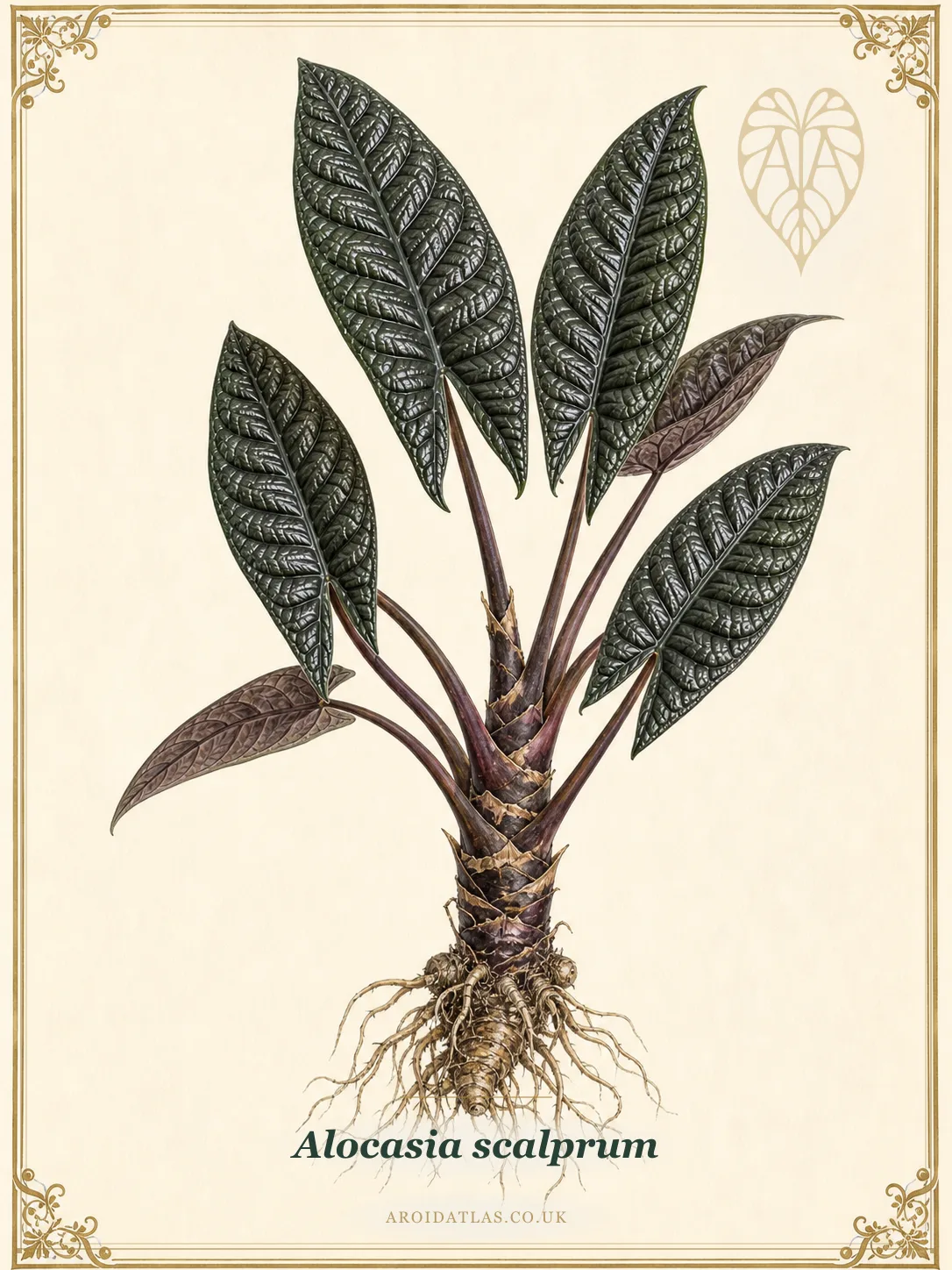
Full Specimen Plate
Alocasia suhirmaniana
Suhirman's Alocasia
- Flowers of Sulphur, 99.99% PurityDusted onto a fresh corm or rhizome cut to guard against rot before repotting.
- Precision Bonsai Pruning Scissors, 200mmFine-bladed snips for clean node cuts when taking a cutting.
Amazon links — we may earn commission on qualifying purchases.
7cm Target Price
£10.00
Alocasia suhirmaniana Morphology
About Alocasia suhirmaniana
Alocasia suhirmaniana was formally described by Yuzammi and Alistair Hay in 1998, published in Telopea. It is endemic to Southeast Sulawesi, where it inhabits humid lowland forest floors overlying nickel-rich ultramafic soils. The plant produces broad sagittate leaves with silvery-grey primary veins that contrast against dark green tissue and deep purple-violet undersides. In domestic cultivation, specimens enter cold-induced dormancy if root zone temperatures drop below 18°C.
Native Range
Sulawesi, Indonesia
Market Hub
Alocasia suhirmaniana Sold Prices & Live Market
What the Target Price above is based on: eBay sold prices by plant size, live listings, and retailer stock.
No eBay sales recorded yet. Sold listings are collected as they appear on eBay.
Before You Buy
Species-specific things to check when evaluating a listing
- Confirm the presence of active white root tips rather than an unrooted raw corm
- Examine the purple abaxial lamina for spider mite webbing or puncture damage
- Verify the petiole base is firm and free of soft bacterial rot
- Ensure the specimen possesses at least two established leaves
Propagation Guide
How to Propagate Alocasia suhirmaniana
Propagation Guide
How to Propagate Alocasia suhirmaniana
8-12 weeks
Cultivar character is preserved through vegetative cuttings
Harvest mature corms from the root ball during spring repotting; incubate in damp perlite at 24 C.
Care Guide
Alocasia suhirmaniana Care Guide & Growing Conditions
Care Guide
Alocasia suhirmaniana Care Guide & Growing Conditions
Coarse aroid mix containing pumice, pine bark, horticultural charcoal, and perlite for drainage
Allow the upper third of the substrate to dry between waterings to protect the suhirmaniana corm
Maintain ambient humidity above 70% to prevent marginal necrosis on suhirmaniana leaf blades
Apply dilute balanced liquid fertilizer at quarter strength every two weeks during leaf emergence
Repot suhirmaniana every two years in spring when roots emerge from drainage holes
Common Problems
Rapid senescence of older leaves
Suhirmaniana corm nutrient depletion or root zone temperatures dropping below 18 C
Maintain temperatures near 24 C and apply dilute potassium fertilizer to sustain multiple leaves
Abaxial spider mite infestation
Low air humidity combined with stagnant warm conditions beneath purple leaf undersides
Rinse leaf undersides with tepid water and apply insecticidal horticultural oil or predatory mites
Field Reference
In the Wild
Field Reference
In the Wild
Field Notes
Field Notes: Ultramafic Soils of Southeast Sulawesi
Yuzammi and Alistair Hay published Alocasia suhirmaniana in 1998 in the journal Telopea, naming the taxon in honour of Indonesian botanist Dr. Suhirman. Wild populations are restricted to lowland rainforests in Southeast Sulawesi, growing in thin leaf litter overlying mineral-rich ultramafic substrates. The deep purple-violet pigmentation on the leaf underside reflects unabsorbed green wavelengths back through the photosynthetic layer in deep shade. Cultivated plants remain sparse in trade collections due to this narrow geographic range and slow corm offset production.