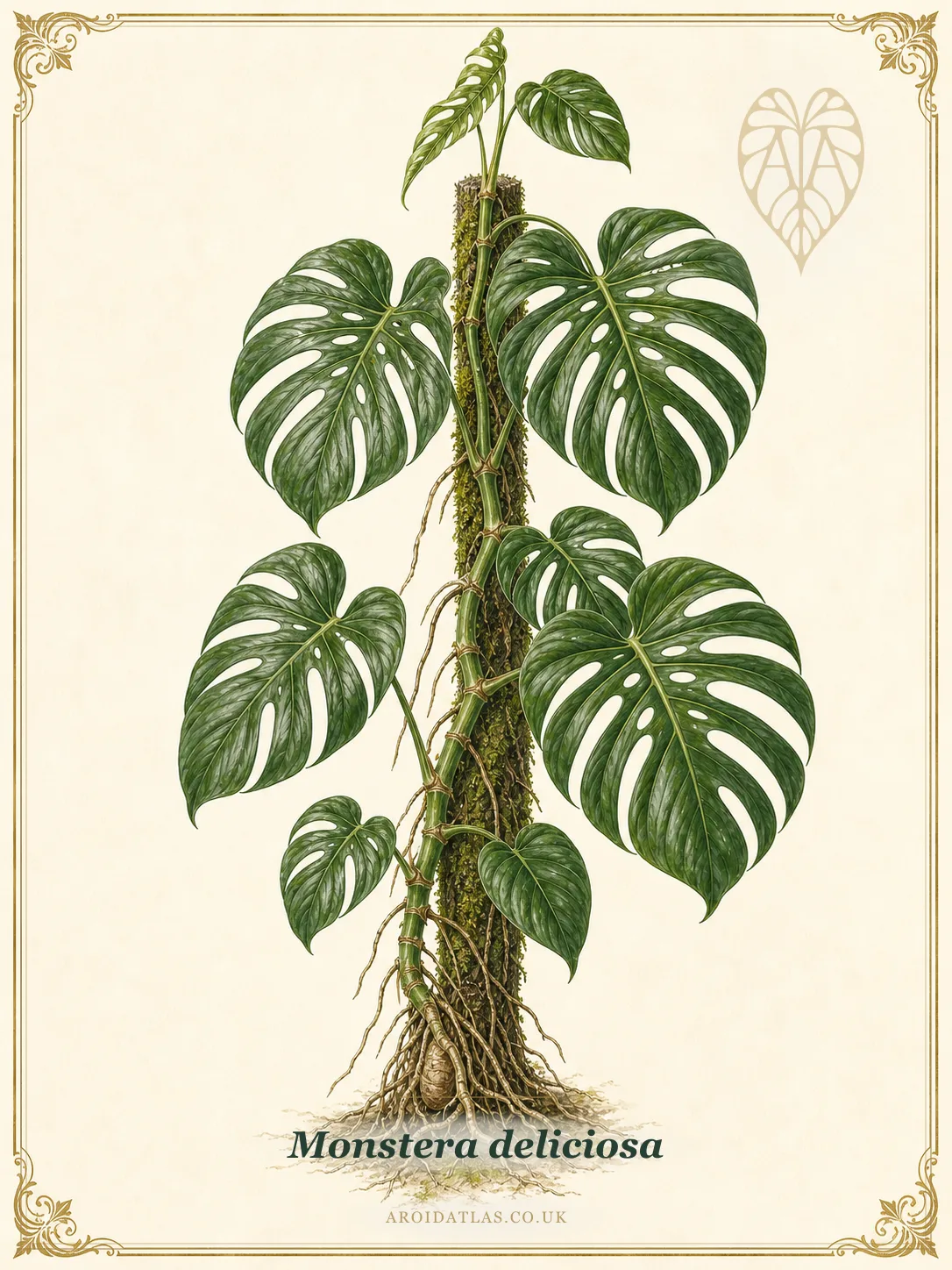
Full Specimen Plate
Monstera deliciosa var. borsigiana
Borsigiana Monstera
- Coir Moss Pole, 120cm (4-Pack)Coco coir totem for climbing aroids to root into as they grow upward.
- Natural Rooting Powder, 3 x 75gRooting hormone powder for stem and leaf cuttings.
- Precision Bonsai Pruning Scissors, 200mmFine-bladed snips for clean node cuts when taking a cutting.
Amazon links — we may earn commission on qualifying purchases.
7cm Target Price
£14.00
Monstera deliciosa var. borsigiana Morphology
About Monstera deliciosa var. borsigiana
Monstera deliciosa var. borsigiana is a recognised, more compact botanical variety of the standard Monstera deliciosa. Somewhat confusingly for buyers, it is actually the form most commonly sold in general houseplant retail under the plain 'Monstera deliciosa' name. Compared to the true type species, borsigiana has thinner, more delicate leaves, shorter internodes, and a smoother, non-ridged petiole, and it reaches fenestration and climbing maturity noticeably faster and at a smaller overall size. The split-leaf silhouette and easy care associated with Monstera deliciosa are fully present here, in a quicker-growing, more compact package.
Market Hub
Monstera deliciosa var. borsigiana Sold Prices & Live Market
What the Target Price above is based on: eBay sold prices by plant size, live listings, and retailer stock.
No eBay sales recorded yet. Sold listings are collected as they appear on eBay.
Before You Buy
Species-specific things to check when evaluating a listing
- Most 'Monstera deliciosa' sold in general retail is actually this variety. Check the petiole for a smooth, non-ridged texture and shorter internodes to confirm
- Very common and inexpensive, so be cautious of collector-level prices
- Check for a healthy node and aerial root activity if buying a cutting
- Inspect leaf undersides for spider mites, a common issue in dry indoor conditions
Propagation Guide
How to Propagate Monstera deliciosa var. borsigiana
Propagation Guide
How to Propagate Monstera deliciosa var. borsigiana
2-4 months
Cultivar character is preserved through vegetative cuttings
Roots readily from stem or node cuttings with an aerial root or visible node, in water or moist substrate.
Care Guide
Monstera deliciosa var. borsigiana Care Guide & Growing Conditions
Care Guide
Monstera deliciosa var. borsigiana Care Guide & Growing Conditions
Well-draining aroid mix: 40% potting compost, 30% orchid bark, 30% perlite.
Water when the top 4-5 cm of substrate is dry.
Tolerates average household humidity; higher humidity encourages larger, more fenestrated leaves.
Balanced liquid fertiliser at half strength every 4 weeks during the growing season.
Annually while young given its fast growth, then every 1-2 years once mature.
Common Problems
Small, unfenestrated leaves
Juvenile plant or insufficient light/support to climb
Provide a moss pole and bright indirect light; fenestration develops with maturity and vertical growth
Root rot
Overwatering or poor drainage
Repot into fresh, well-draining substrate and reduce watering frequency
Field Reference
In the Wild
Field Reference
In the Wild
Field Notes
The Monstera You Probably Already Own
Here is a small, mildly irritating truth of the houseplant trade: if you own a 'Monstera deliciosa' bought from an ordinary garden centre, there is a fair chance it is actually this variety, borsigiana, rather than the true type species: thinner leaves, a smooth non-ridged petiole, and noticeably faster growth are the tells. It is, if anything, the more practical plant for most collections: quicker to fenestrate, more compact, and just as happy climbing a moss pole toward the ceiling.