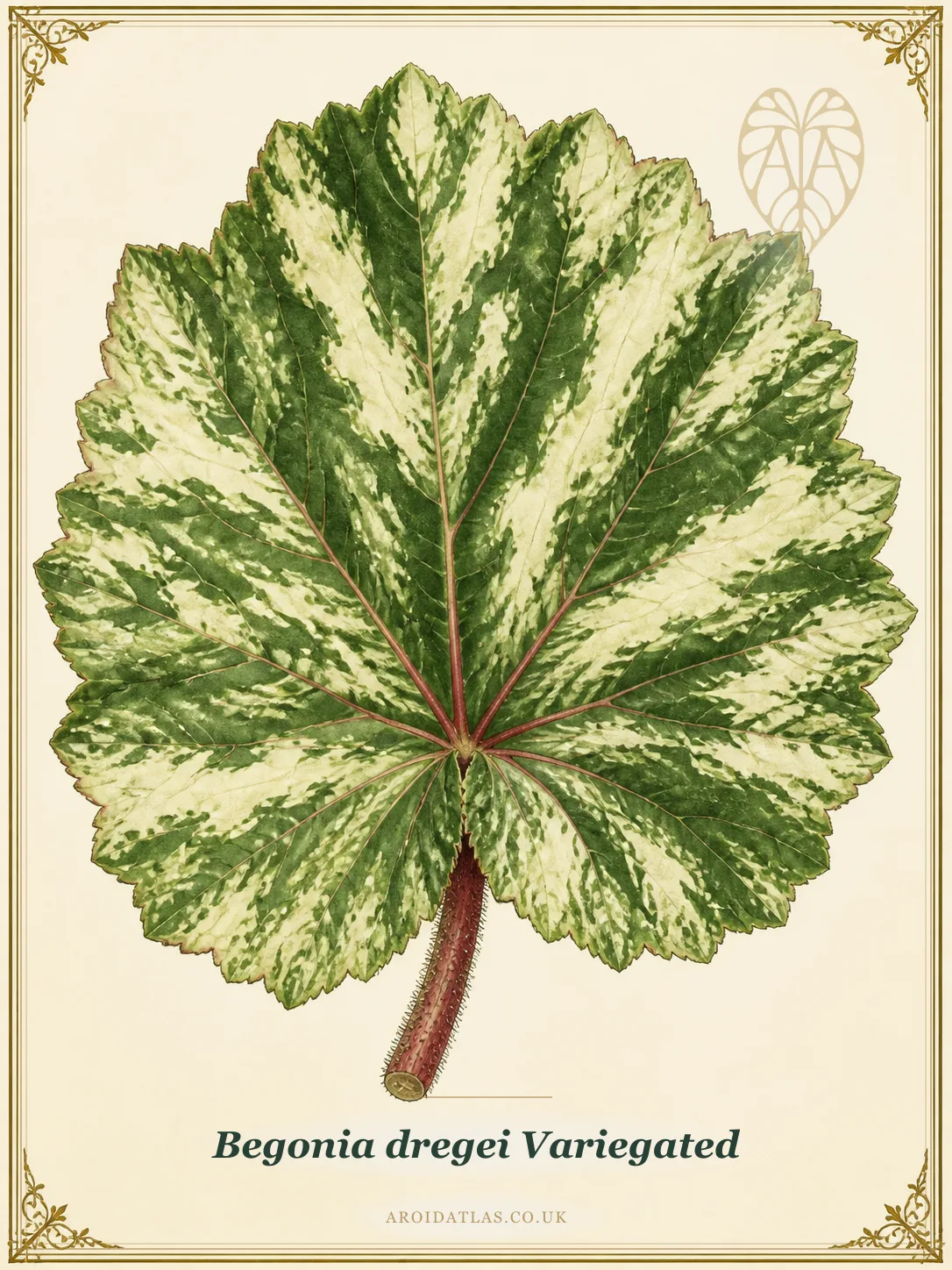
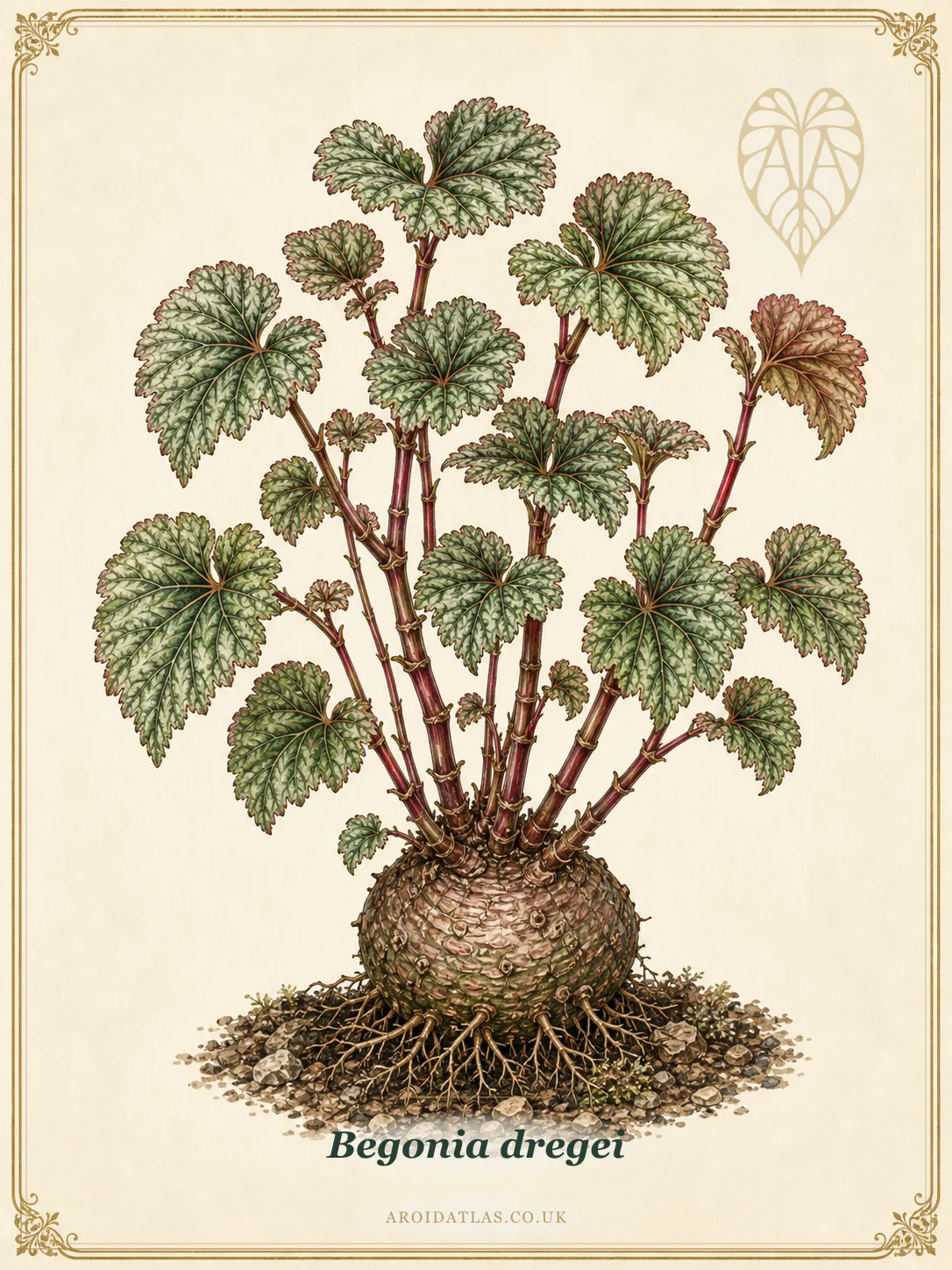
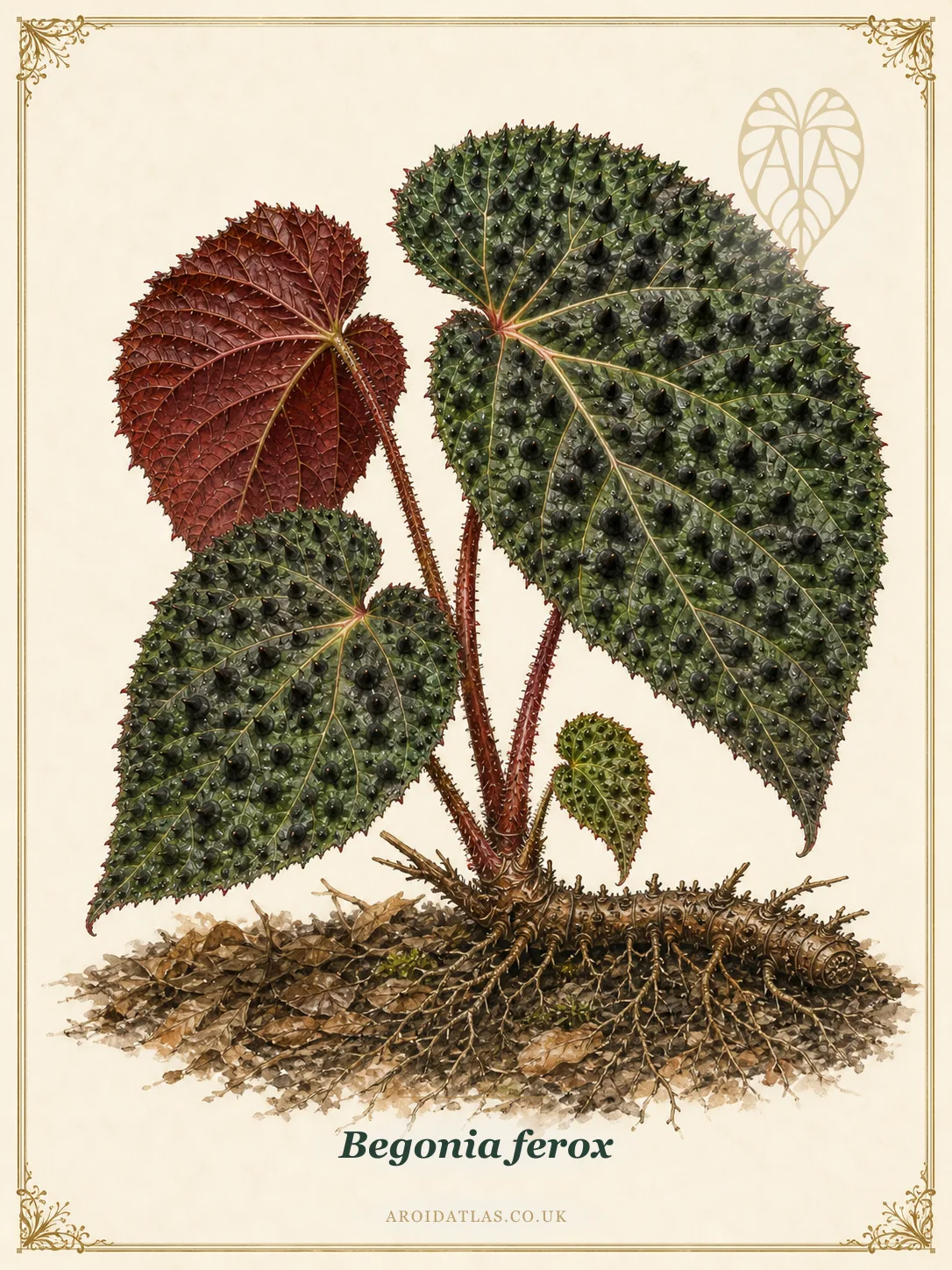
Full Specimen Plate
Begonia burkillii
Burkill's Himalayan Begonia
- Natural Rooting Powder, 3 x 75gRooting hormone powder for stem and leaf cuttings.
- Precision Bonsai Pruning Scissors, 200mmFine-bladed snips for clean node cuts when taking a cutting.
- Digital Hygrometer & ThermometerLCD humidity and temperature gauge for checking a grow spot against a plant's target range.
Amazon links — we may earn commission on qualifying purchases.
7cm Target Price
£15.00
Begonia burkillii Morphology
About Begonia burkillii
Stephen Troyte Dunn published Begonia burkillii in 1920, naming it after British botanist Isaac Henry Burkill. The plant is native to Arunachal Pradesh in the Eastern Himalaya of Northeast India, where it grows as a lithophyte along shaded river valleys. It exhibits elliptical peltate leaves with a mint-green base marked by chocolate-brown blotches and an iridescent blue sheen in dim light. Unlike lowland tropical species, this montane begonia requires cool temperatures and declines when exposed to heat above 25 C.
Native Range
India
Market Hub
Begonia burkillii Sold Prices & Live Market
What the Target Price above is based on: eBay sold prices by plant size, live listings, and retailer stock.
No eBay sales recorded yet. Sold listings are collected as they appear on eBay.
Before You Buy
Species-specific things to check when evaluating a listing
- Confirm the buyer can maintain cool temperatures below 24 C during summer months
- Check the peltate petiole insertion for firm attachment without rot
- Examine chocolate-brown markings for clean margins free of fungal spotting
- Verify the rhizome is firm and anchored by roots
Propagation Guide
How to Propagate Begonia burkillii
Propagation Guide
How to Propagate Begonia burkillii
10-12 weeks
Cultivar character is preserved through vegetative cuttings
Leaf cuttings root reliably under cool conditions between 18 C and 20 C; avoid warm propagation boxes.
Care Guide
Begonia burkillii Care Guide & Growing Conditions
Care Guide
Begonia burkillii Care Guide & Growing Conditions
Airy mix of kanuma, pumice, chopped sphagnum moss, and aged leaf mold
Maintain even moisture; allow top layer to dry slightly before watering with pure rainwater
Maintain 75% to 90% relative humidity in a cool growing area
Apply dilute balanced fertilizer at one-quarter strength once per month during spring
Repot in early spring into wide shallow pans to accommodate horizontal burkillii rhizome growth
Common Problems
Sudden leaf collapse and rhizome softening
Ambient temperatures exceeding 25 C combined with saturated substrate
Move to a cooler room below 22 C and increase airflow while easing watering
Fading of blue iridescence and chocolate markings
Excessive light exposure breaking down shade-adapted pigment structures
Move to deep indirect shade below 150 foot-candles
Field Reference
In the Wild
Field Reference
In the Wild
Field Notes
Field Notes: The Abor Expedition of 1911-1912
Begonia burkillii was discovered during the 1911-1912 Abor Expedition into the Himalayan foothills of Arunachal Pradesh by Isaac Henry Burkill. Stephen Troyte Dunn published the formal description in 1920 at the Royal Botanic Gardens, Kew. In its native habitat, it clings to moss-covered rocks along shaded gorges where cool mountain air settles. The leaf exhibits structural iridescence, an optical feature that enhances photosynthesis under dim forest canopies.