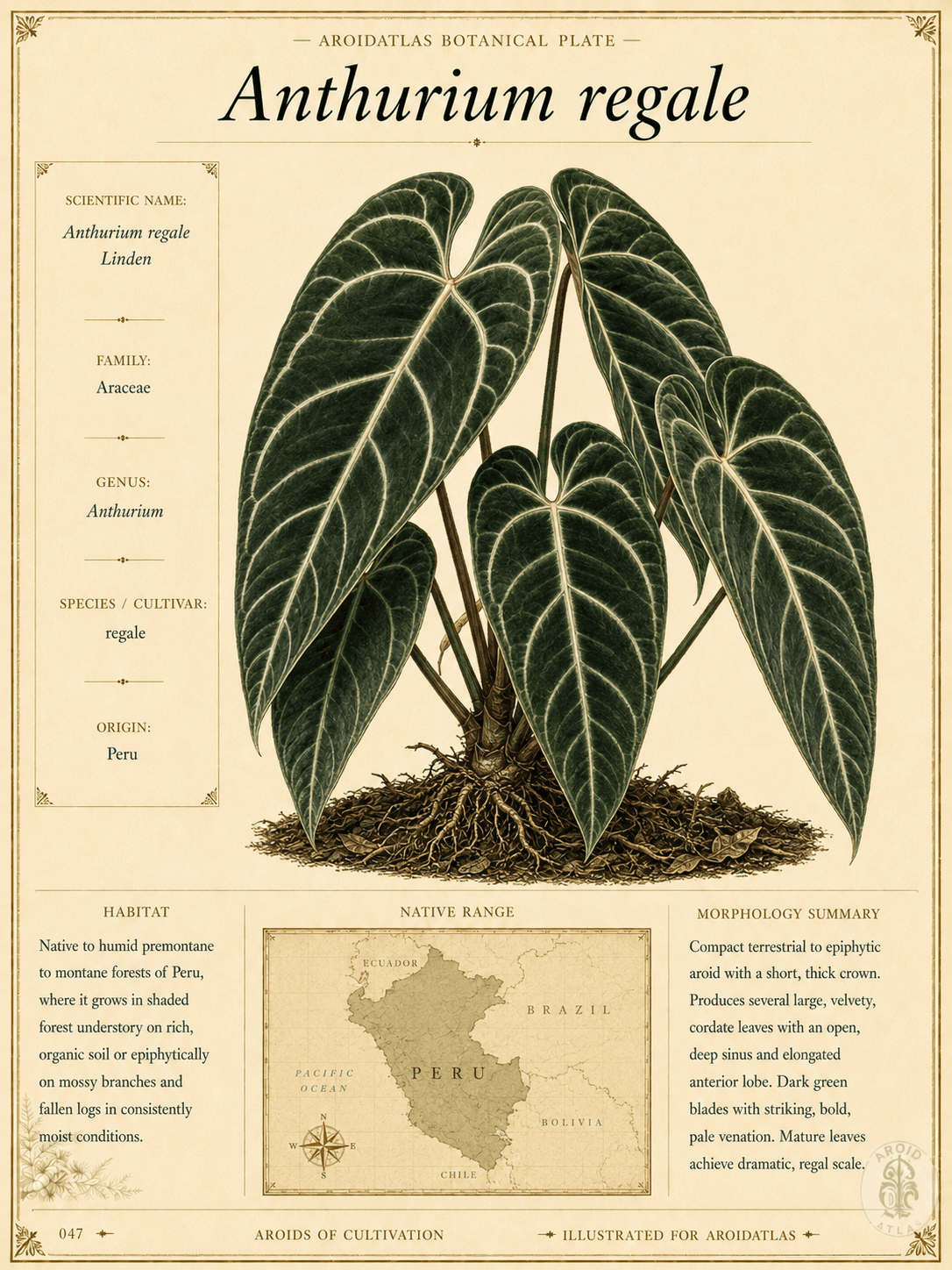
Full Specimen Plate
Anthurium faustomirandae
Fausto Miranda's Anthurium
Aroid Atlas Price Guide
Select Plant Size
Pricing Data Key
Community price estimate based on limited sales history
Market Analysis
Anthurium faustomirandae Price Guide & Auction Value
Historical eBay auction metrics and live retailer listings updated weekly.
No eBay auction history available yet. Data is collected automatically as sales appear on eBay UK.
Before You Buy
Species-specific things to check when evaluating a listing
- Inspect new growth carefully for thrips — check the undersides of unfurling leaves for tiny dark insects or silvery streaking, as velvet anthuriums are a primary target
- Roots should be firm and pale — mushy or dark roots indicate rot often caused by poor transit conditions
- Avoid plants with more than one yellowing leaf; minor leaf loss in transit is normal but multiple yellows suggest stress before shipping
- Request a photo of the most recently unfurled leaf to judge current health — a crispy or damaged newest leaf is a red flag
Anthurium faustomirandae Morphology
About Anthurium faustomirandae
Anthurium faustomirandae is a basal Anthurium described by Pérez-Farrera and Croat, endemic to the humid tropical forest of Chiapas, Mexico. It grows on moist terrestrial soils or limestone rock faces in shaded ravines and slopes with consistently high humidity and rich organic matter year-round. The defining characteristic is the heavily bullate, quilted leaf surface — thick, coriaceous and velvety deep green, with strongly raised primary venation giving the blade a sculptured quality. Stout upright petioles arise from a short crown, and the plant grows terrestrially or lithophytically within its restricted natural range. Among Mexican anthuriums, faustomirandae is notable for combining extreme natural rarity with a leaf texture found nowhere else in the genus.
Native Range
Mexico
Propagation Guide
How to Propagate Anthurium faustomirandae
One of the most challenging anthuriums to propagate. Rarely produces offshoots. Stem cuttings require perfect humidity and warmth over many months. Best left to specialist growers.
Care Guide
Anthurium faustomirandae Care Guide & Growing Conditions
Very chunky, well-aerated mix: 40% orchid bark, 30% perlite, 20% sphagnum moss, 10% activated charcoal. Anthuriums suffocate in dense soil — roots need airflow.
Water when the substrate is nearly dry throughout. Less is more — overwatering is the primary killer of velvet anthuriums. Always use room-temperature water.
70–85% is essential. Below 60% causes stunted growth and curling leaves. A dedicated humidifier is strongly recommended for UK growers.
Low-nitrogen fertiliser (e.g. 5-10-10 or orchid fertiliser) at quarter strength every 3–4 weeks. High nitrogen produces lush but weak growth susceptible to pests.
Reluctantly — only when completely root-bound (every 2–3 years). These plants dislike disturbance and may sulk after repotting.
Common Problems
Yellowing leaves
Overwatering or root rot
Remove from pot, trim affected roots, repot into fresh dry substrate and reduce watering
Curling or crispy leaf edges
Low humidity or cold draughts
Increase humidity above 70% and move away from cold windows
Thrips
Common on velvet-leaf anthuriums; hard to detect early
Inspect new growth and leaf undersides regularly; treat with neem oil or systemic insecticide at first sign
Limestone, Chiapas, and an Under-Priced Rarity
From the karst limestone habitats of Chiapas in southern Mexico, Anthurium faustomirandae is not merely rare but genuinely unusual: it has developed a specialist rooting system adapted to limestone substrates, which immediately complicates cultivation in the standard British glasshouse context. Described by Croat and Sheffer, it produces large leaves with prominent venation that are impressive in maturity. At current prices it is, in my view, undervalued for what it is — a genuine Mexican limestone endemic with a restricted natural range and limited availability in cultivation. A serious collector's acquisition. Act accordingly.
Also in: Bullate & Corrugate
Species with a raised, quilted or corrugated leaf surface rather than a flat velvet texture.