Why Rare Aroid Prices Fall: Three Case Studies
Houseplant prices in this hobby move almost entirely in one direction: down, as propagation catches up with demand. Three well-tracked cultivars show the same pattern playing out at different speeds.
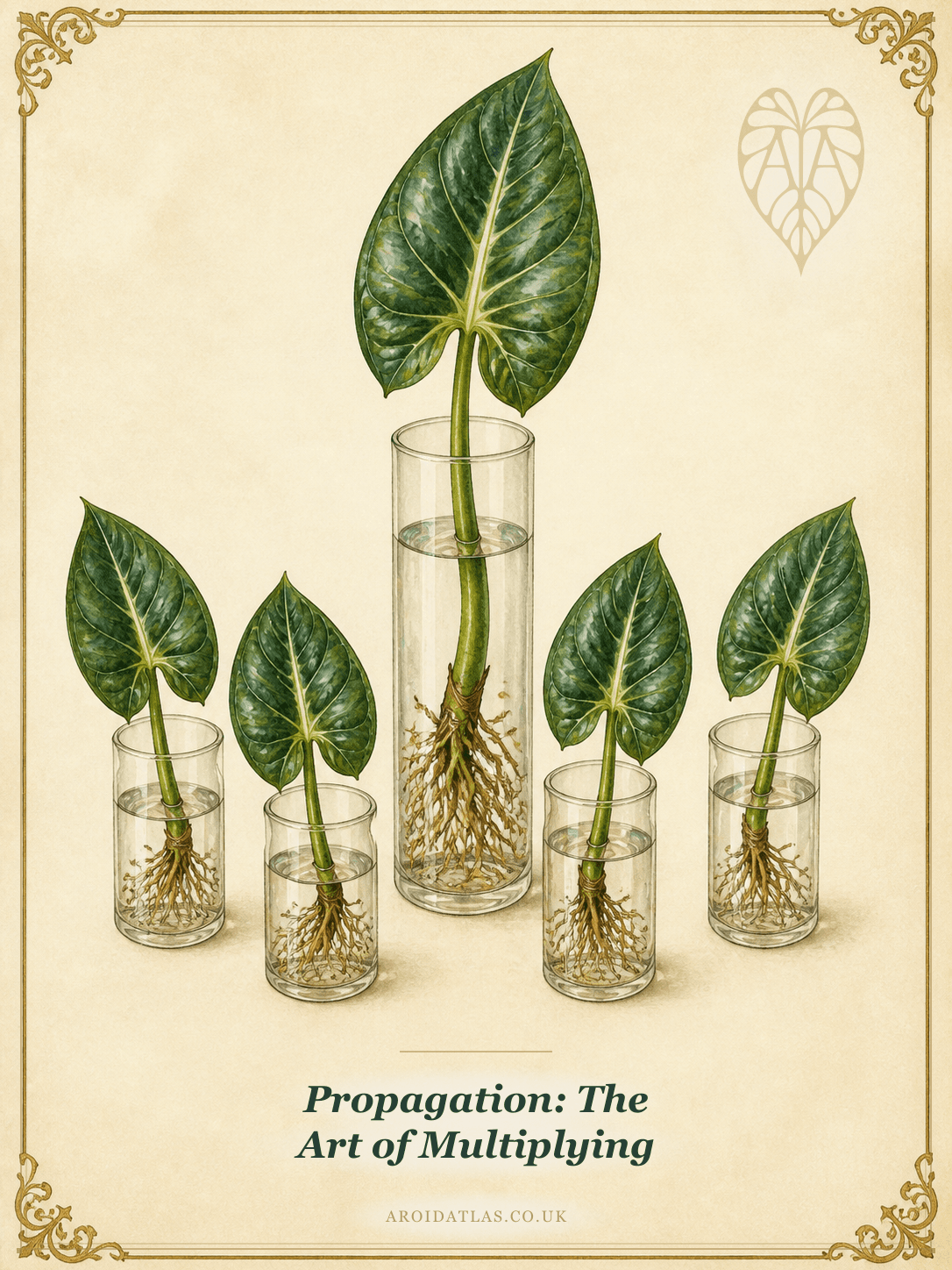
One plant, propagated into many identical cuttings: the supply increase behind every price decline described below.
Scarcity is a supply problem, and supply problems get solved
A rare aroid is expensive because too few plants exist for the number of collectors who want one, not because the plant costs more to grow than a common one. That gap closes as growers propagate the plant, whether through cuttings at scale or tissue culture, and the price falls as supply catches up. The size of the fall and how fast it happens depends mainly on how easy the plant is to mass-produce.
This is why almost nothing in the hobby holds a peak price for long once it's identified as commercially viable. What varies between cultivars is the shape of the decline, gradual for some, a near-vertical drop for others.
Thai Constellation: the tissue-culture cliff
Thai Constellation's variegation is nuclear, present in every cell rather than confined to certain sectors, which makes it genetically stable and, critically, straightforward to multiply through tissue culture. When labs began producing it at volume, individual cuttings that had traded for hundreds of pounds each became a plant sold by the pot at general retailers. The tracked median on this cultivar's page reflects that shift; it sits far below its early-hobby price despite a recent uptick as demand for larger specimens has picked back up.
The lesson isn't that Thai Constellation stopped being desirable. It's that tissue culture removed the bottleneck that made it expensive in the first place, and price followed supply, not the other way around.
Pink Princess: a slower, steadier decline
Philodendron erubescens 'Pink Princess' variegation is stable enough to propagate reliably from cuttings, though not as trivially scalable through tissue culture as Thai Constellation's nuclear pattern. The result is a decline that has been gentler and slower: fewer of the sharp single-quarter drops seen elsewhere, more of a steady grind downward as ordinary cutting propagation across many growers has kept supply climbing year over year.
Spiritus-sancti: scarcity meeting micropropagation
Philodendron spiritus-sancti is a genuinely rare wild species, known from a single restricted area of Atlantic Forest in Espírito Santo, Brazil, and historically priced in the thousands of pounds on that basis. Increasing access to micropropagation has begun supplying the market at meaningfully greater volume than wild collection or hobbyist cuttings ever could, and the tracked price on this site currently reflects a sharp decline over the last three months. Mature, high-character specimens with an established growth history still command a premium; what has fallen is the price of getting a plant into a collection at all.
The pattern behind all three
Every case above follows the same mechanism at a different speed: a plant enters the hobby as genuinely scarce, someone works out how to multiply it reliably, and price falls as that method scales. The plants worth watching for future declines are less the ones already famous for being expensive, and more the ones currently hard to propagate; once a lab or a grower solves that problem, the same cliff tends to follow.
Frequently Asked Questions
Does a falling price mean a plant is losing value as a collectible?
No. Price and collectibility are different things. A falling price usually means the plant has become easier to grow at scale, which is generally good news for anyone who wants to actually own one rather than speculate on it.
Will these prices keep falling indefinitely?
Not to zero. Prices tend to find a floor once supply roughly matches steady-state demand, at which point normal costs (pot, substrate, grower time, shipping) set a baseline. A mature, well-grown specimen also holds a premium over a bare cutting indefinitely, regardless of how common the cultivar becomes.
How is the three-month change on this site calculated?
It compares the current tracked median against the median from roughly three months earlier, both drawn from completed UK eBay sales for that specific plant, not the wider genus.
Referenced Plants
Related Species
This guide applies directly to the following genera in our archive: