Tissue Culture vs Cuttings: Why Lab-Produced Plants Cost Less
A tissue-culture plant and a stem cutting of the same cultivar can sell for very different amounts. The gap comes down to how each one is produced, not how healthy either turns out to be.
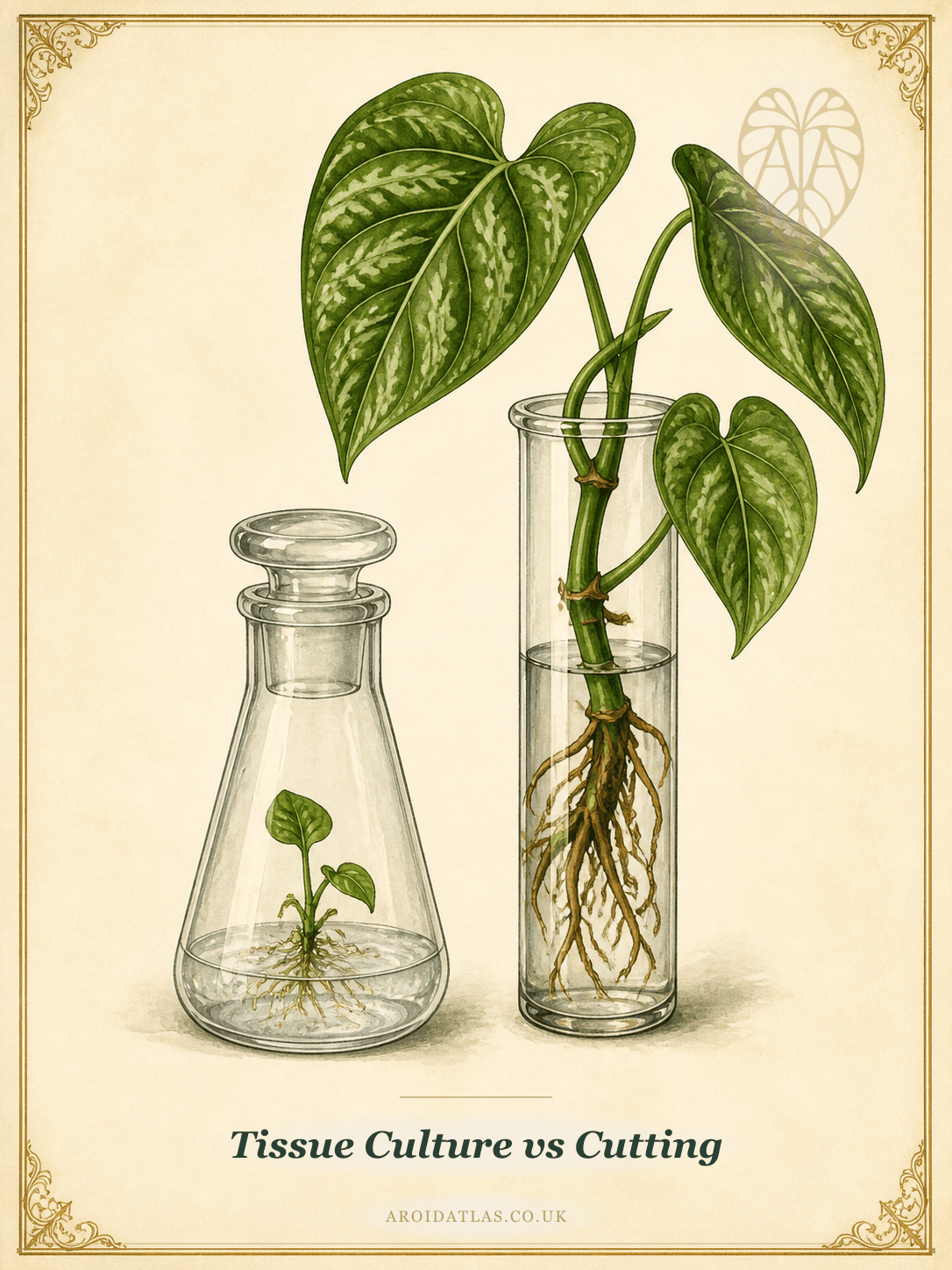
A lab flask plantlet beside a rooted stem cutting: the same cultivar, produced two different ways, priced two different ways.
What tissue culture actually is
Tissue culture takes a small amount of plant material, often just a few cells from a growth point, and multiplies it in sterile lab conditions on a nutrient gel rather than in soil. A single donor plant can produce many hundreds of genetically identical plantlets this way, all of which then need to be gradually acclimatised out of the sterile flask environment before they're sold as ordinary potted plants.
The output scales in a way ordinary propagation never can. A grower taking stem cuttings by hand is limited by how many nodes a mother plant produces in a season; a lab running tissue culture is limited mainly by flask capacity and the plant's tolerance for the process, which for viable species is a far higher ceiling.
Why that difference shows up directly in price
Price in this hobby tracks supply closely, and tissue culture is the single biggest lever available for increasing supply of a given cultivar. A plant that was scarce because only a handful of growers held mother stock becomes, within a couple of years of entering tissue culture production, available from dozens of sellers at once. Thai Constellation's price history is the clearest example of this mechanism working at full speed.
Not every cultivar tissue-cultures well. Some variegation patterns are chimeric, meaning they're confined to certain cell layers rather than present throughout the plant, and lab micropropagation from those layers can produce inconsistent or reverted results. That's part of why some unstable variegated forms have stayed expensive even in an era where tissue culture has crashed the price of comparable-looking plants elsewhere in the hobby.
Why collectors still pay more for a cutting
A rooted stem cutting from a known, mature mother plant carries information a fresh tissue-culture plantlet can't: it shows exactly what that specific genetic line looks like at maturity, whether the variegation pattern holds up on larger leaves, and how vigorously it grows outside a lab environment. For chimeric or highly variable cultivars, buyers will pay a premium for a cutting taken from a leaf whose pattern they can already see, rather than gambling on however a tissue-culture plantlet turns out.
Tissue-culture plants also go through a de-flasking and acclimatisation period where losses are common; a seller offering an established, already-acclimatised cutting is charging in part for having absorbed that risk already.
Frequently Asked Questions
Is a tissue-culture plant lower quality than a cutting?
Not inherently. Once fully acclimatised and established, a tissue-culture plant grows the same as any other. The price difference reflects supply and buying certainty, not plant health.
How do I know if a listing is a tissue-culture plant or a cutting?
Sellers of tissue-culture stock usually say so directly, often listing plants in batches at a consistent size and price. A cutting listing typically shows the specific mother plant and states node count or root state individually.
Does tissue culture always crash a cultivar's price eventually?
For cultivars that tissue-culture reliably, yes, this is close to the standard pattern once a lab picks it up at scale. Cultivars with unstable chimeric variegation are the main exception, since lab propagation from those layers is less reliable.
Referenced Plants
Related Species
This guide applies directly to the following genera in our archive: