Grow Room Gear for Collectible Aroids
The recurring equipment behind most aroid collections: what a moss pole, LECA, a humidity dome, sphagnum moss, rooting powder, and a grow light are each actually for.
Support and substrate
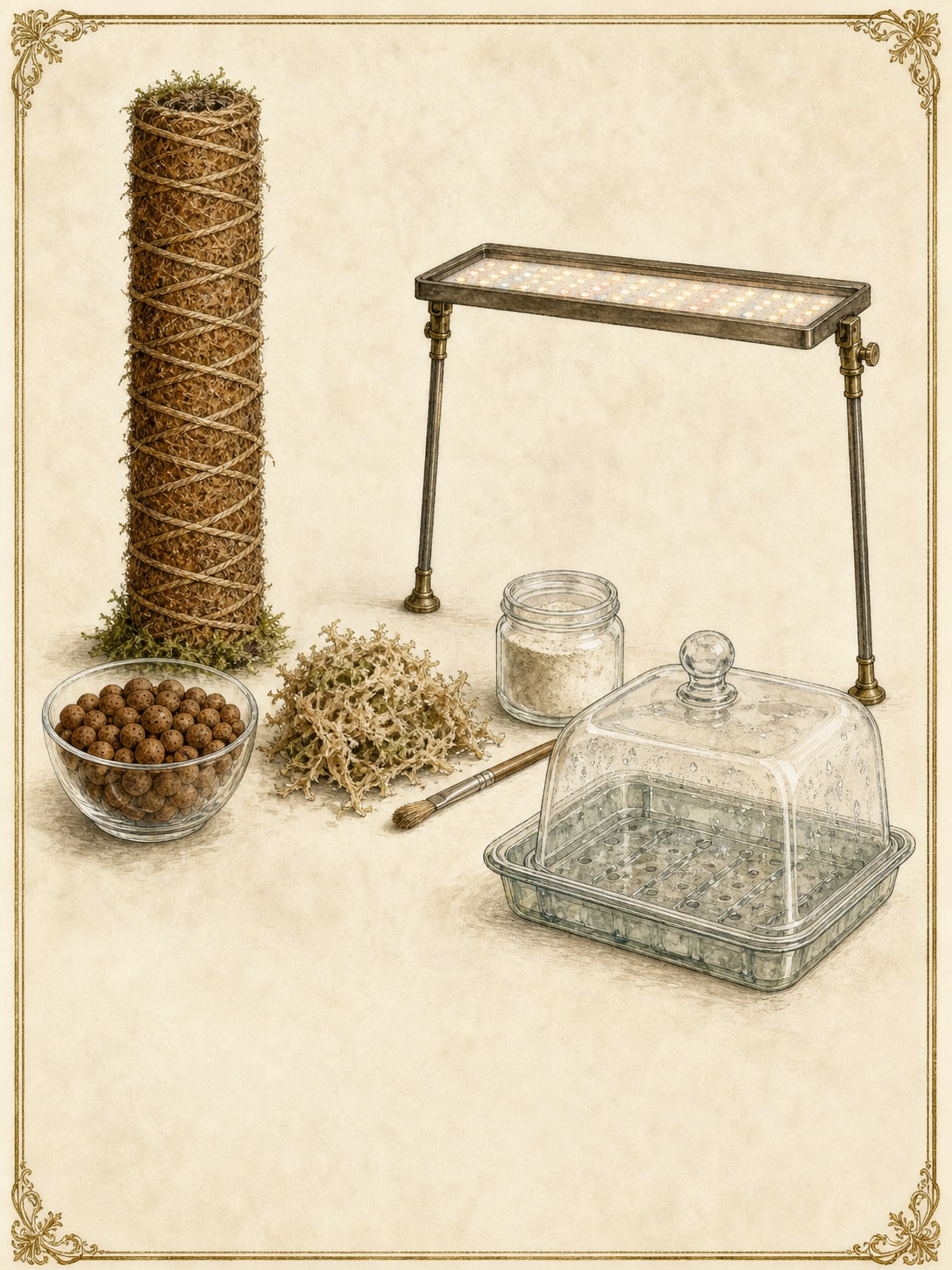
A climbing aroid (Monstera, most Philodendron, Rhaphidophora, Epipremnum, Scindapsus) grows larger, more fenestrated leaves once it has something to climb, since the plant reads contact with a support as a signal to mature past its juvenile leaf form. A coir-wrapped moss pole gives aerial roots something to grip and hold moisture against the stem, which matters more than the pole's height; a plant will keep producing new growth up a pole that's shorter than its final size.
LECA (lightweight expanded clay aggregate) is the substrate behind semi-hydroponic culture: fired clay balls that hold water in a reservoir at the bottom of the pot while wicking moisture up to the roots, with no organic matter to break down or attract fungus gnats. It's also useful as a straight drainage layer under a normal soil mix for anyone not ready to convert a whole plant to semi-hydro.
Sphagnum moss holds many times its own weight in water while staying airy enough that roots don't sit in stagnant conditions, which is why it shows up in air-layering, as a top-dressing to raise humidity around a stem, and as a component in chunky aroid mixes for epiphytic species.
Orchid bark and worm castings are the other two components behind our Substrate Calculator's chunky aroid mix. Bark keeps a mix open and slow to compact, since it takes years rather than months to break down; worm castings add a slow-release nutrient source without the salt build-up a synthetic feed can leave behind in a pot that only gets flushed occasionally.
Propagation
A humidity dome traps moisture around a fresh cutting while it has no roots of its own to take up water, cutting down on the wilting and leaf loss that a cutting left in open room air is prone to. Vented models let that humidity be dialled back gradually as roots establish, rather than pulled off all at once.
Rooting hormone powder isn't required for most aroid cuttings to root, but it shortens the time a cutting spends vulnerable to rot by triggering root initiation faster. Dip the cut end, tap off the excess, and it's most useful on slower-rooting genera and on stem cuttings taken without a node already showing root initials.
A clean cut matters as much as anything applied to it afterward. Precision snips leave a smooth wound that seals quickly, where a dull blade or garden secateurs can crush stem tissue and open the door to rot. For corms and rhizomes specifically (Alocasia, Colocasia, Caladium), a dusting of sulphur powder on the fresh cut face guards against fungal rot while the wound calluses over, before it goes back into substrate.
Light
Where a room can't offer bright, indirect light for most of the day, a full-spectrum LED panel run on a timer for 12–14 hours makes up the difference. This matters most for variegated plants: the white or yellow sectors on a leaf carry little chlorophyll, so the remaining green tissue needs more usable light to keep the whole leaf fed, and an under-lit variegate often pushes new growth with less pattern rather than more. Our lighting guide covers how to judge whether a spot actually needs supplementing before buying a light.
A PPFD meter replaces guesswork with an actual number: point it at the exact spot the plant's canopy sits, not the windowsill, and read the usable light in µmol/m²/s directly rather than trusting how bright a room looks to the eye.
Gear Used in This Guide
Amazon links — we may earn commission on qualifying purchases. This doesn't affect the price you pay.
Coir Moss Pole, 120cm (4-Pack)
Coco coir totem for climbing aroids to root into as they grow upward.
View on Amazon UKLECA Clay Pebbles, 4-16mm (10lb)
Expanded clay aggregate for semi-hydroponic culture and drainage layers.
View on Amazon UKHumidity Dome, Heavy-Duty Germination Kit
Vented propagation dome for holding humidity around fresh cuttings.
View on Amazon UKPremium New Zealand Sphagnum Moss, 100g
Long-fibre sphagnum for air-layering, top-dressing, and epiphyte substrate mixes.
View on Amazon UKNatural Rooting Powder, 3 x 75g
Rooting hormone powder for stem and leaf cuttings.
View on Amazon UKFull-Spectrum LED Grow Light Panel
144-LED panel with IR and UV for supplementing light in low-light rooms.
View on Amazon UKDigital Hygrometer & Thermometer
LCD humidity and temperature gauge for checking a grow spot against a plant's target range.
View on Amazon UKHorticultural Perlite, 3-5mm Grade (5L)
Expanded volcanic glass for aeration and drainage in a soil-based mix.
View on Amazon UKDigital PAR/PPFD Light Meter
Measures usable light at leaf height in µmol/m²/s, rather than relying on the eye's sense of brightness.
View on Amazon UKOrchiata Orchid Bark, 100% Pure NZ Pinus Radiata
Chunky bark component for aroid mixes, holds structure for years without breaking down.
View on Amazon UKWorm Castings, Organic Multipurpose Fertiliser
Slow-release organic nutrient component for a chunky aroid mix.
View on Amazon UKPrecision Bonsai Pruning Scissors, 200mm
Fine-bladed snips for clean node cuts when taking a cutting.
View on Amazon UKFlowers of Sulphur, 99.99% Purity
Dusted onto a fresh corm or rhizome cut to guard against rot before repotting.
View on Amazon UKFrequently Asked Questions
Do I need all of this to keep a collectible aroid alive?
No. A healthy plant in a well-lit spot with a normal watering routine doesn't need a moss pole, LECA, or a grow light to survive. This gear speeds up growth, extends leaf size, or removes a specific bottleneck (light, humidity during propagation, climbing support) rather than being baseline requirements.
Is LECA a straight swap for soil?
Not directly. Converting an established soil plant to LECA means washing all the soil off the roots and adjusting the watering routine to a reservoir system rather than periodic soaking, so it's usually done deliberately at repotting rather than as a quick substrate swap.
How long does a cutting need a humidity dome for?
Until it has visible new root growth, typically a few weeks depending on the genus and season. Vent it gradually over the final week or two rather than removing it outright, so the cutting isn't shocked by the sudden drop in humidity.
Related Species
This guide applies directly to the following genera in our archive: