Watering & Mineral Nutrition
Overwatering is the number one killer of rare collectibles. Water when the top 50% of the pot dries, and fertilize weakly with every watering.
Watering by moisture, not by schedule
The single most common cause of death in collectible aroids isn't disease or pests; it's a fixed watering schedule applied regardless of how quickly a specific pot, substrate, and season are actually drying out. A chunky mix in a terracotta pot in summer might need water every four days; the same mix in a glazed ceramic pot in a cool winter room might not need it again for three weeks. Watering by the calendar in either direction leads to either root rot or dehydration.
The most reliable test is physical: water again once the top 50% of the substrate depth has dried out, checked by inserting a finger or a wooden skewer to that depth rather than judging from the surface alone, which dries faster than the root zone beneath it. When you do water, drench thoroughly until water runs freely from the drainage holes, then let the pot dry down fully before watering again. A thorough soak followed by a proper dry-down cycle encourages deeper, healthier root growth than frequent shallow watering.
Step by Step
Follow the trail below, one component at a time — each illustrated in the same antique botanical plate style used across our species archive.
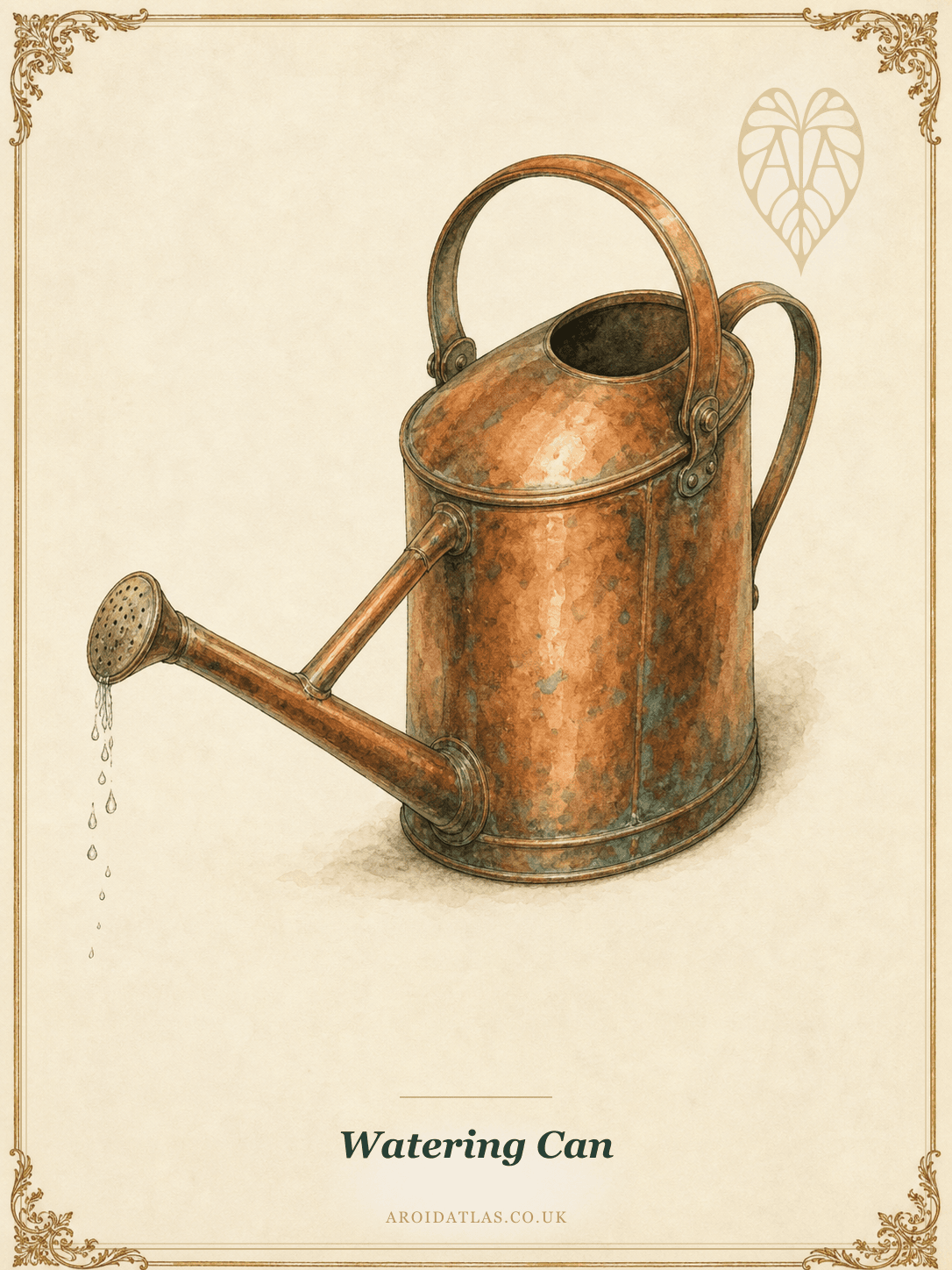
Watering Can
Rainwater or stood tap water, applied slowly and evenly across the substrate surface, gives every part of the root zone a fair chance to absorb moisture before excess drains away.
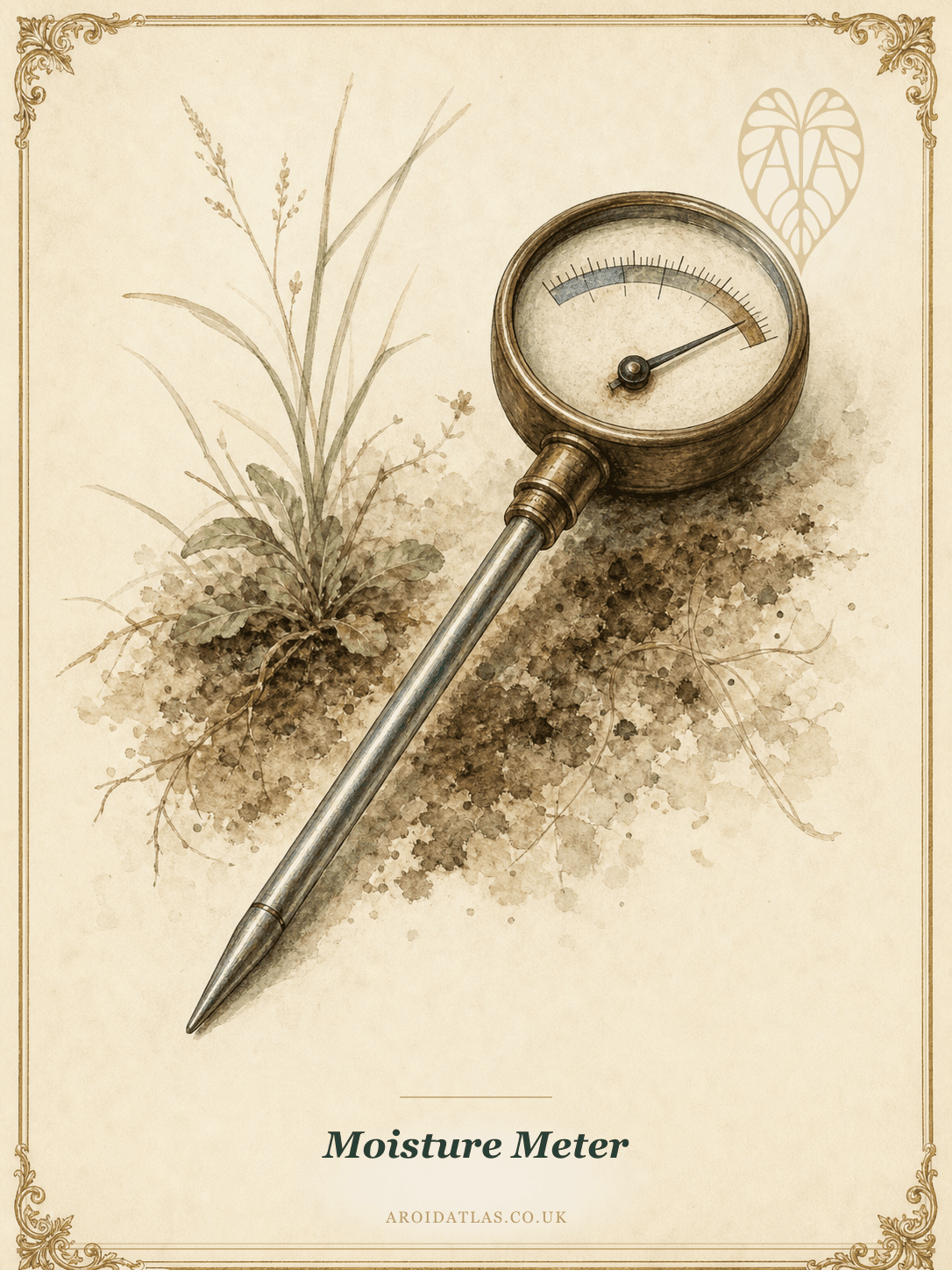
Moisture Meter
A probe inserted to the mid-depth of the pot confirms whether the top 50% of the substrate has actually dried out, replacing guesswork with a reading taken below the deceptively dry-looking surface.
Metal probes can react with mineral-heavy tap water and drift over time; rinse and dry yours after every use.
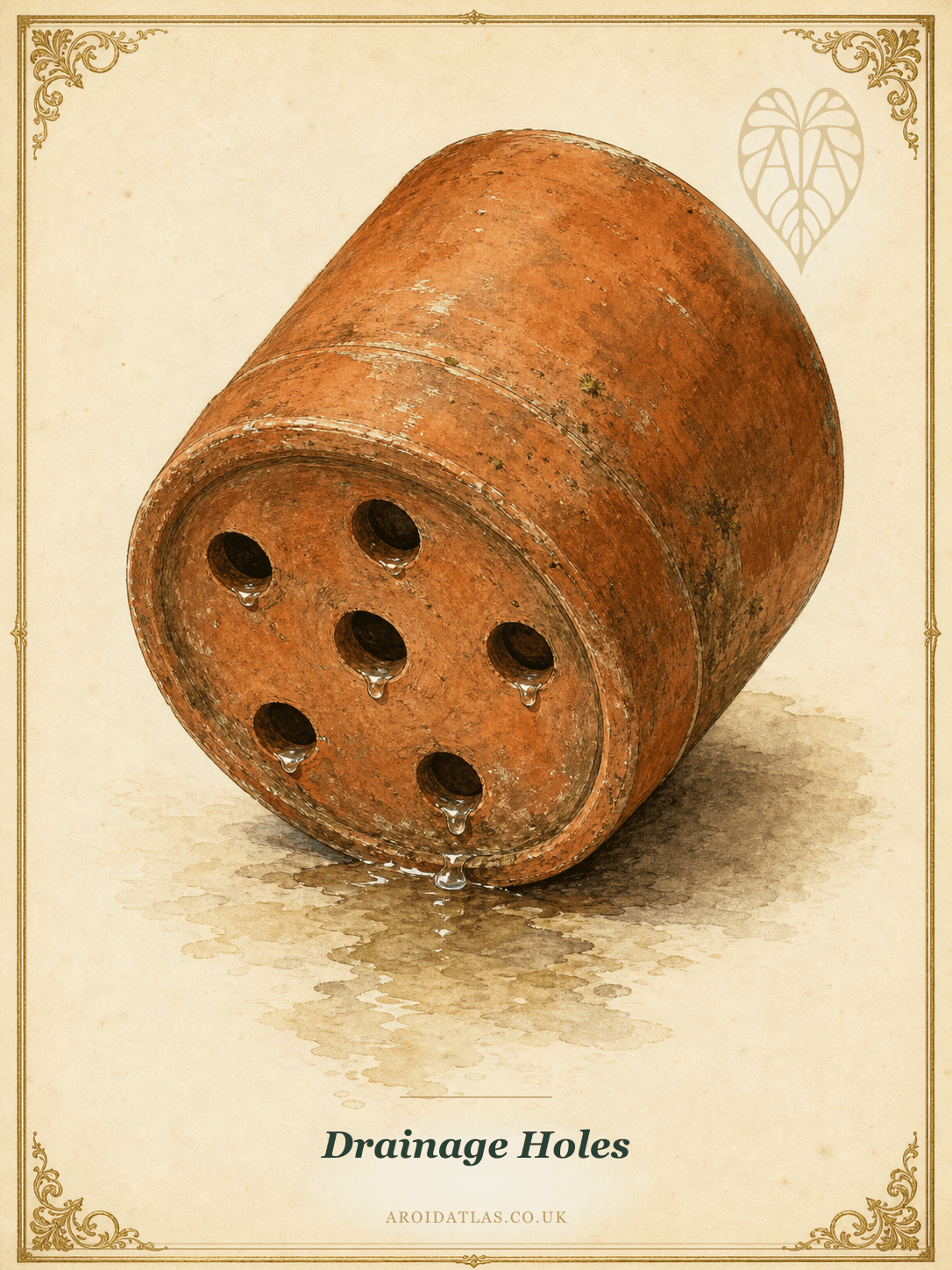
Drainage Holes
A thorough drench that runs freely out through generous drainage holes flushes stale air from the substrate and encourages roots to grow deeper in search of the next watering.
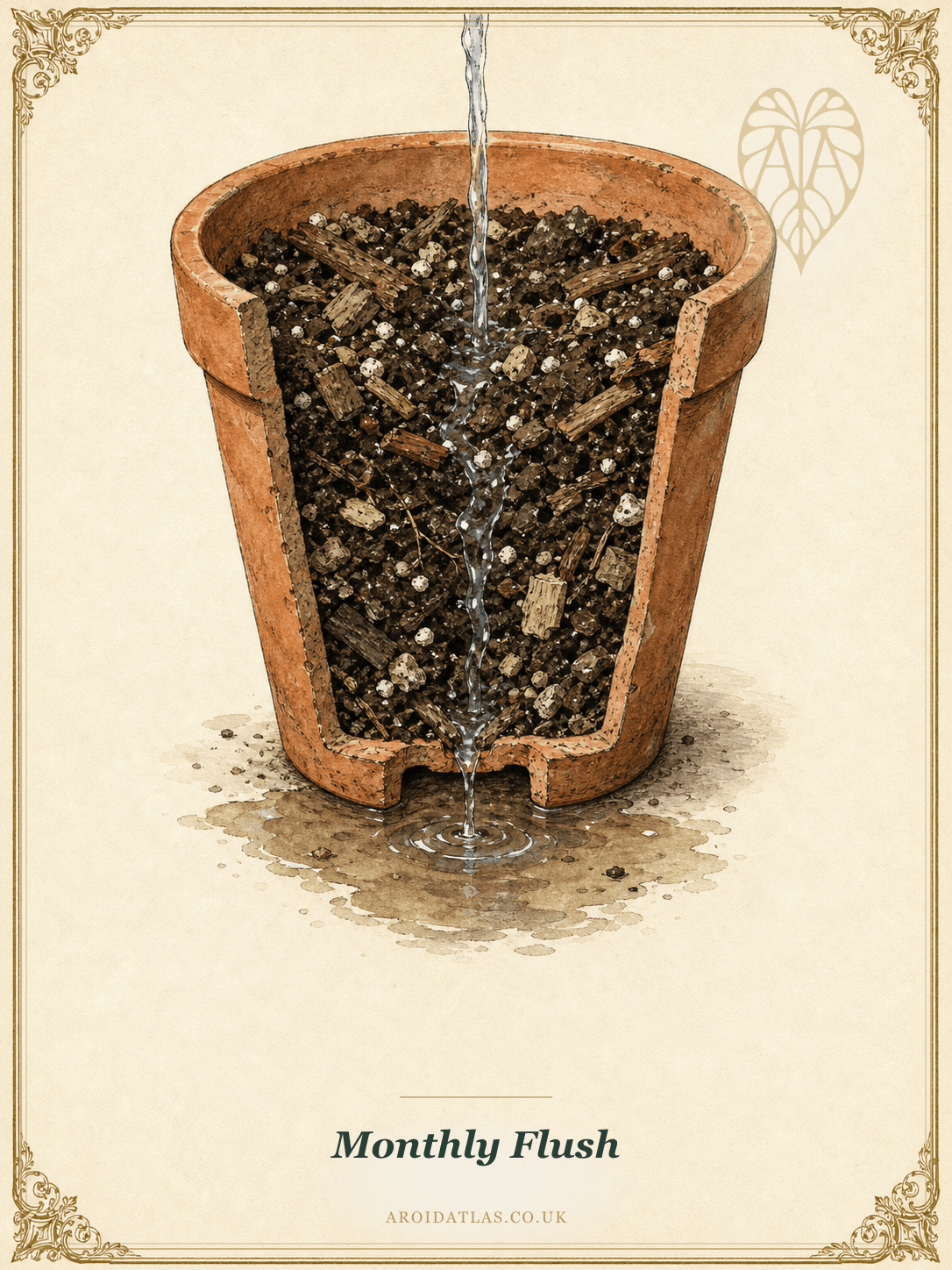
Monthly Flush
Running several times the normal watering volume straight through the pot once a month clears the mineral salt build-up that ordinary watering leaves behind, keeping the root zone from crusting over.
Do this over a sink or outdoors. It's messier than it sounds, and the runoff is exactly the salt build-up you're trying to get rid of.
Water quality for sensitive species
Tap water in much of the UK carries enough dissolved minerals and chlorine to cause visible leaf-tip browning over time in sensitive genera, particularly Anthurium. Rainwater or reverse-osmosis (RO) water avoids this almost entirely and is worth the extra effort for high-value or notoriously fussy specimens; for hardier genera like Philodendron and Monstera, tap water left to stand for 24 hours to off-gas chlorine is usually sufficient.
Where water quality can't be controlled, flushing the substrate with a large volume of pure water once a month (several times the pot's normal watering volume, run straight through and out the drainage holes) helps prevent the gradual mineral salt build-up that shows up as a white crust on the substrate surface and a slow decline in root health.
Feeding weakly, weekly
A balanced, nitrogen-forward liquid fertiliser (formulations like 9-3-6 or 3-1-2 are common for foliage-focused aroids) diluted to roughly a quarter of label strength and applied with most waterings during the growing season delivers a steady nutrient supply without the salt spikes a full-strength monthly feed produces. This 'weakly, weekly' approach mimics the low, constant nutrient trickle a plant would receive from decomposing leaf litter in the wild, rather than the boom-and-bust cycle of infrequent heavy feeding.
Reduce or pause feeding through the darker winter months when growth naturally slows. Nutrients a dormant or slow-growing plant isn't using simply accumulate in the substrate as salts, with no corresponding benefit.
Lift the pot instead of testing every time
Once you know how a freshly watered pot feels in your hand versus a dry one, lifting it becomes just as reliable as a skewer or moisture meter for day-to-day checks, and far faster once you're managing more than a handful of plants.
Not all fertilisers are actually complete
Plenty of all-purpose feeds are NPK-only and skip secondary nutrients entirely. Formulas built specifically for foliage plants that include calcium, magnesium and a full micronutrient package (Dyna-Gro's Foliage-Pro 9-3-6 is the one most often recommended in aroid-collector circles for exactly this reason) tend to show up as noticeably better leaf size and colour over a season than a basic balanced feed.
A cheap TDS meter tells you what your water's hiding
Dip a TDS (total dissolved solids) meter in your tap water and you'll quickly see how mineral-heavy it is. Consistently high readings are a common hidden cause of leaf-tip browning that often gets blamed on a watering schedule instead.
Bottom watering has its place
Standing a pot in a shallow tray and letting it wick water up through the drainage holes waters the root zone evenly without disturbing the surface. It's not a full substitute for the occasional top-down flush described above, since salts still need flushing out eventually, but it's a useful technique to keep alongside it.
Related Species
This guide applies directly to the following genera in our archive: