Stable vs Unstable Variegation: What Actually Holds Its Pattern
Not all variegation behaves the same way once it leaves the mother plant. Knowing whether a pattern is genetically fixed or a chimeric sport changes what a cutting will actually grow into, and what a fair price looks like.
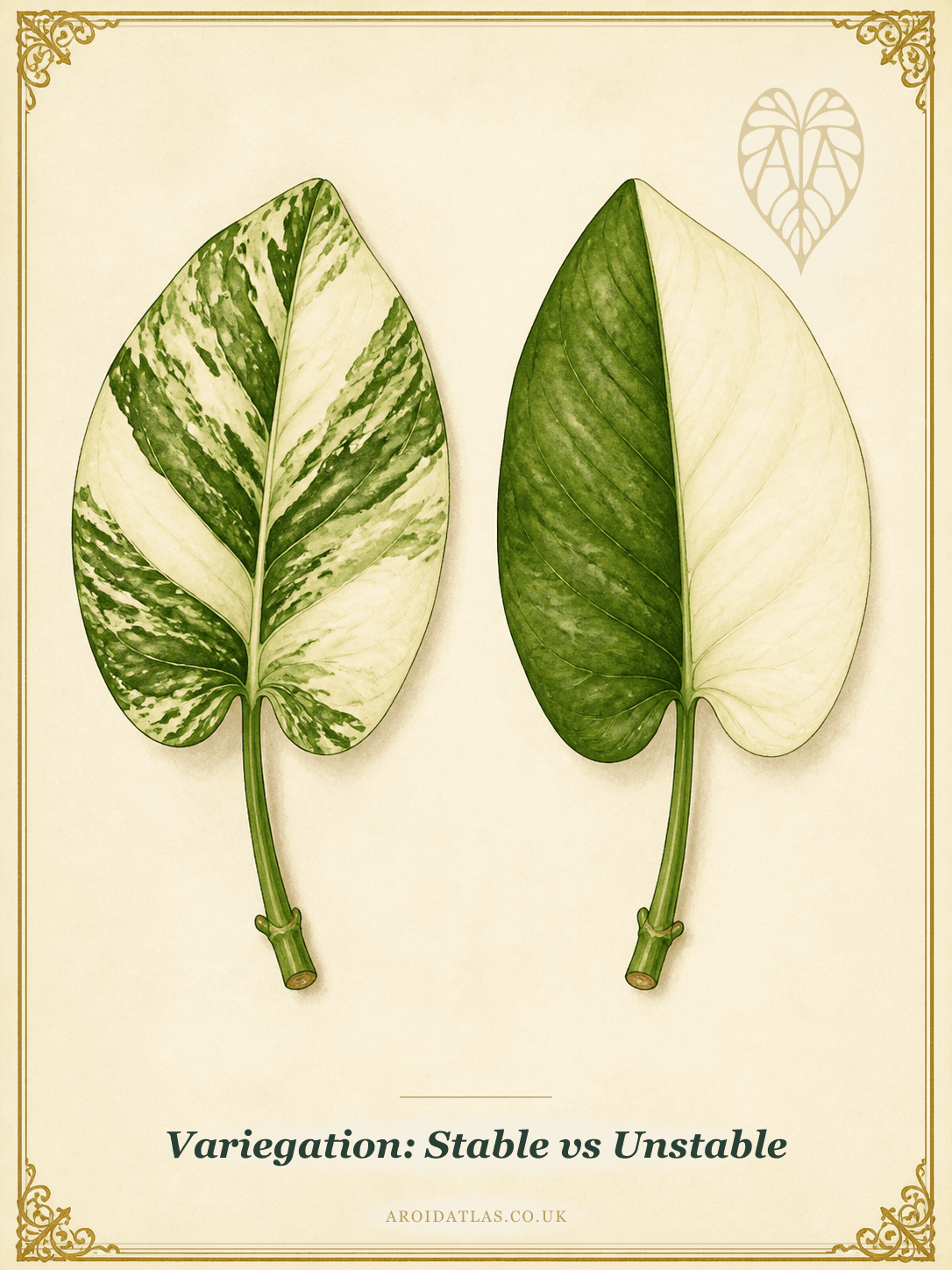
Even marbling on the left against a clean half-and-half split on the right: the same word, 'variegated,' describing two genetically different situations.
Nuclear variegation: fixed in every cell
Nuclear variegation is a genetic change present in every cell of the plant, which means it reproduces true from any cutting taken from any point on the plant. Thai Constellation is the clearest example in the hobby: because its cream-yellow marbling is nuclear rather than chimeric, a cutting from any node grows into a plant with the same variegation pattern as its parent, which is exactly what made it viable to mass-produce through tissue culture in the first place.
A plant with nuclear variegation is a comparatively safe purchase from a pure genetics standpoint. What you see in the listing photo is close to what any cutting from that plant, taken by anyone, will produce.
Chimeric variegation: a sport that can revert
Chimeric variegation is a mutation confined to certain cell layers or sectors of the plant rather than present throughout it, and it is unstable by nature. A cutting taken from a fully green section of an otherwise variegated plant grows into a fully green plant; a cutting taken from a heavily white section can lack enough chlorophyll to survive at all. Monstera deliciosa 'Albo Variegated' is the standard example: its irregular cream-white marbling is chimeric, which is exactly why variegation percentage and the specific leaf or node a cutting is taken from matter so much to its price, and why the plant can revert toward plain green over successive generations of propagation.
Philodendron spiritus-sancti 'Variegated' shows the same instability at the extreme end: expression varies not just plant to plant but leaf to leaf on the same specimen, and a cutting only propagates true if it's taken at a node that is itself variegated.
Known scam patterns to watch for
The most documented case in the hobby's history is the 'Pink Congo' Philodendron, sold widely a few years ago with vivid solid-pink foliage. The colour was not stable variegation at all; it was achieved by chemically or hormonally treating a plain green plant, and the pink faded to green as the treatment wore off over subsequent growth. Any listing showing uniform, unnaturally saturated colour with no green sectors at all on a species not otherwise known for stable pigment mutation is worth treating with real suspicion.
A more common, lower-stakes version of the same problem is a seller photographing a highly variegated 'money leaf' from a plant's history rather than the actual cutting or plant being sold. Ask specifically whether the pictured leaf is the one you'll receive.
Frequently Asked Questions
How can I tell if a variegation pattern is nuclear or chimeric before buying?
Check whether the cultivar is documented as propagating true from any cutting (nuclear) or only from specific variegated nodes (chimeric). This is usually established knowledge for named cultivars rather than something you can tell from a single photo.
Is chimeric variegation always a red flag?
No. It's the normal, expected mechanism behind most of the hobby's classic variegated forms, including Monstera Albo. It just means the specific leaf and node the cutting is taken from matters far more to what you'll actually get than it does on a nuclear cultivar.
What should I do if a plant I bought as variegated starts reverting to green?
This is expected behaviour for chimeric forms, not a sign anything went wrong. Pruning back fully green growth as it appears can help redirect the plant's energy toward the remaining variegated sectors.
Referenced Plants
Related Species
This guide applies directly to the following genera in our archive: