Bright Indirect Light Demystified
Forest canopy climbers receive dappled shade in the wild. Direct sun burns delicate leaves, while low light leads to leggy growth and loss of variegation.
What 'bright indirect' actually means
Under a rainforest canopy, an understory aroid rarely sees the sun directly. Instead it receives a constantly shifting mosaic of dappled light filtered through several layers of foliage overhead: bright but diffuse, and rarely intense enough to cause damage even at midday. Recreating that indoors means positioning a plant where it can see a bright sky through a window without being hit by a direct sun-beam for more than an hour or two, typically achieved with an east-facing window, a west-facing window a metre or two back from the glass, or a south-facing window behind a sheer curtain.
'Low light tolerant' on a plant label is a survival claim, not a growth claim. Many aroids will persist for years in a dim corner without dying, but they won't push new leaves at anywhere near their potential rate, and any variegation will often revert to solid green as the plant tries to maximise chlorophyll for photosynthesis.
Step by Step
Follow the trail below, one component at a time — each illustrated in the same antique botanical plate style used across our species archive.
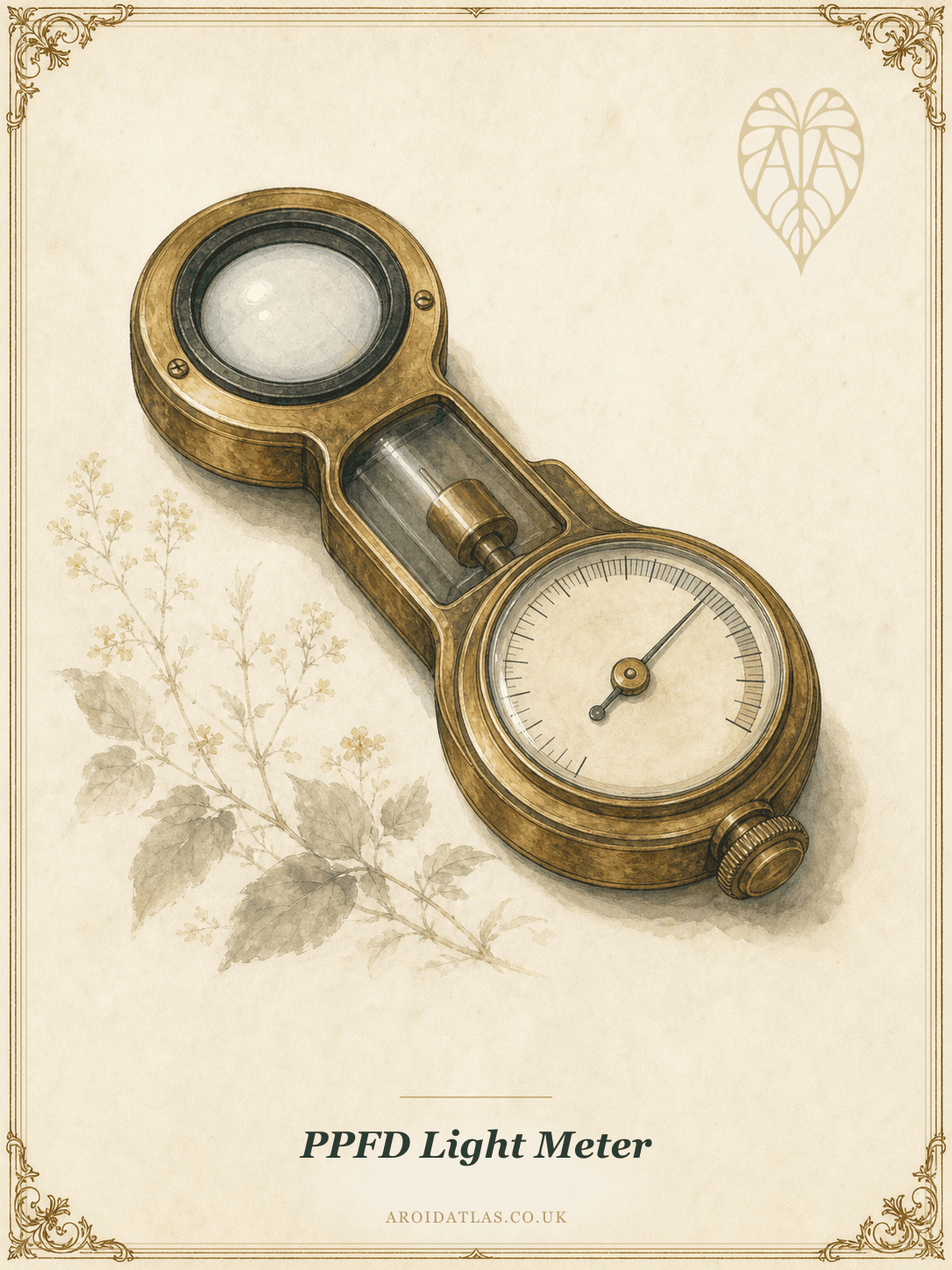
PPFD Light Meter
A dedicated PPFD meter takes the guesswork out of 'bright indirect' by measuring the actual usable light reaching the leaf surface, in µmol/m²/s, rather than relying on the eye's unreliable sense of brightness.
Take readings at midday and again in late afternoon. A spot that looks bright in one may be surprisingly dim in the other.
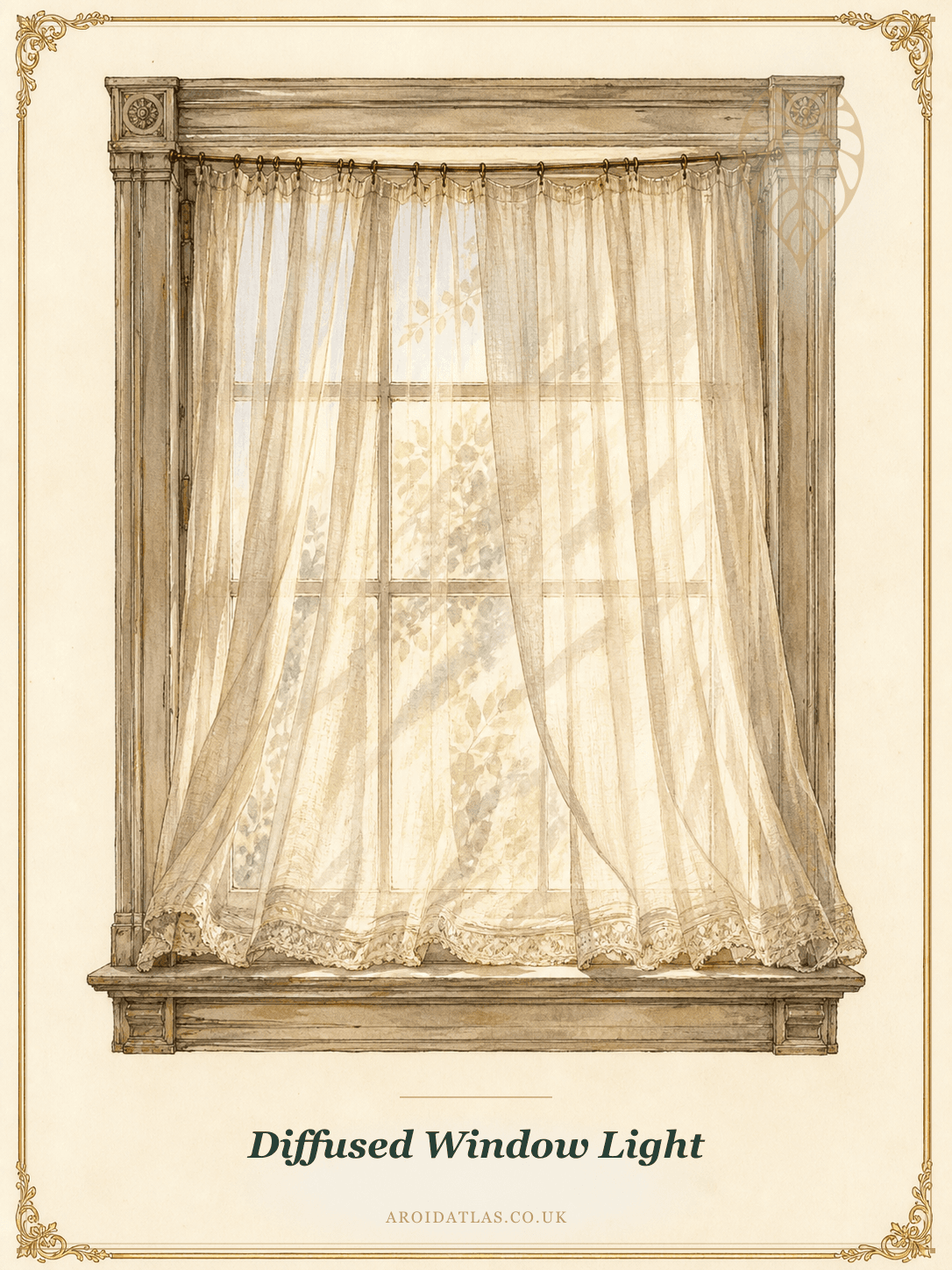
Diffused Window Light
An east-facing window, or any window behind a sheer curtain, scatters direct sun into the soft, even light an understory aroid would receive filtering through a rainforest canopy.
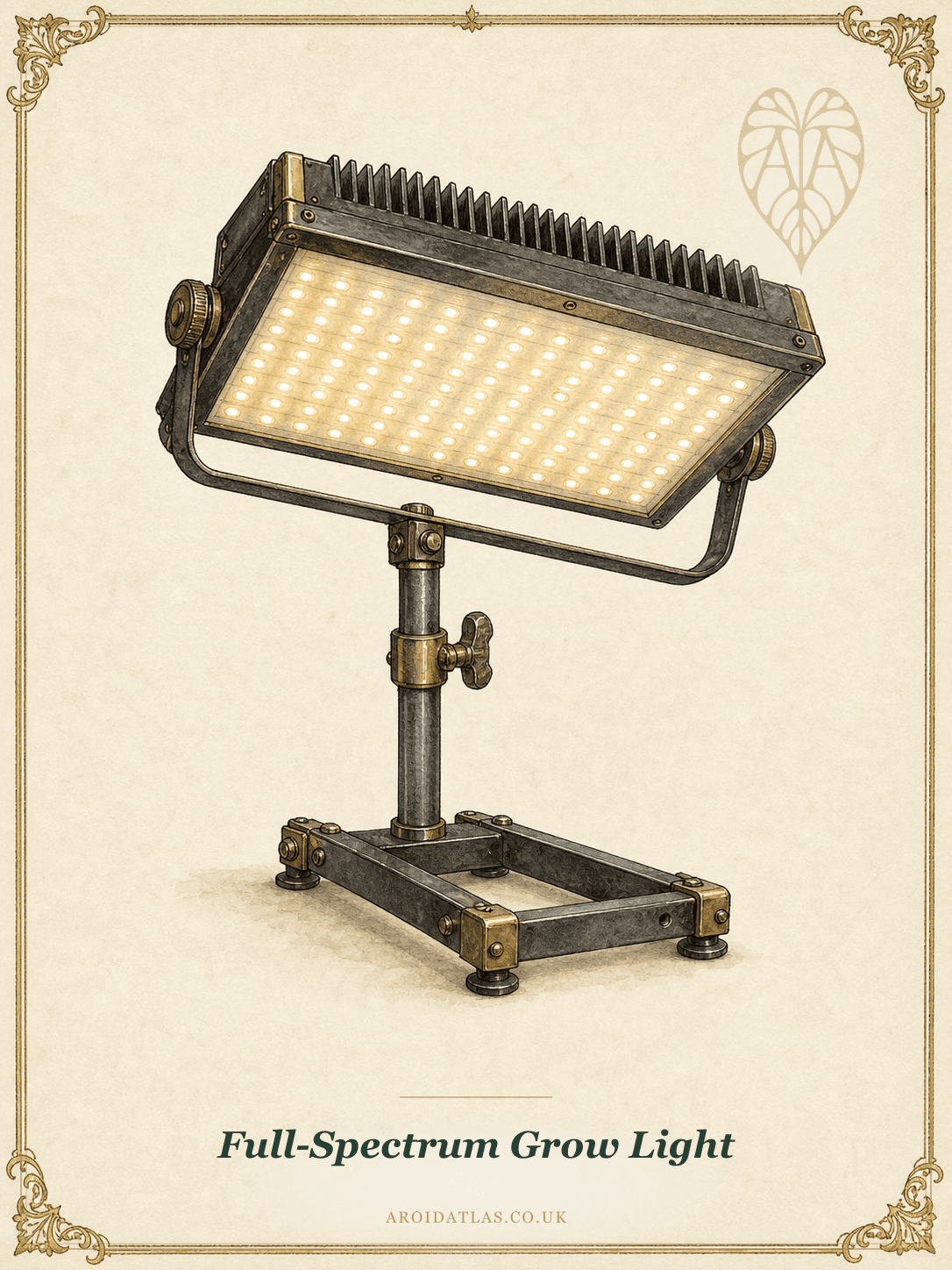
Full-Spectrum Grow Light
A full-spectrum LED fixture run 12-14 hours a day on a timer supplements or entirely replaces natural light, holding a consistent photoperiod that steady, even growth depends on.
A cheap mechanical timer is one of the best-value purchases you'll make for a grow shelf; consistency matters more than raw intensity.
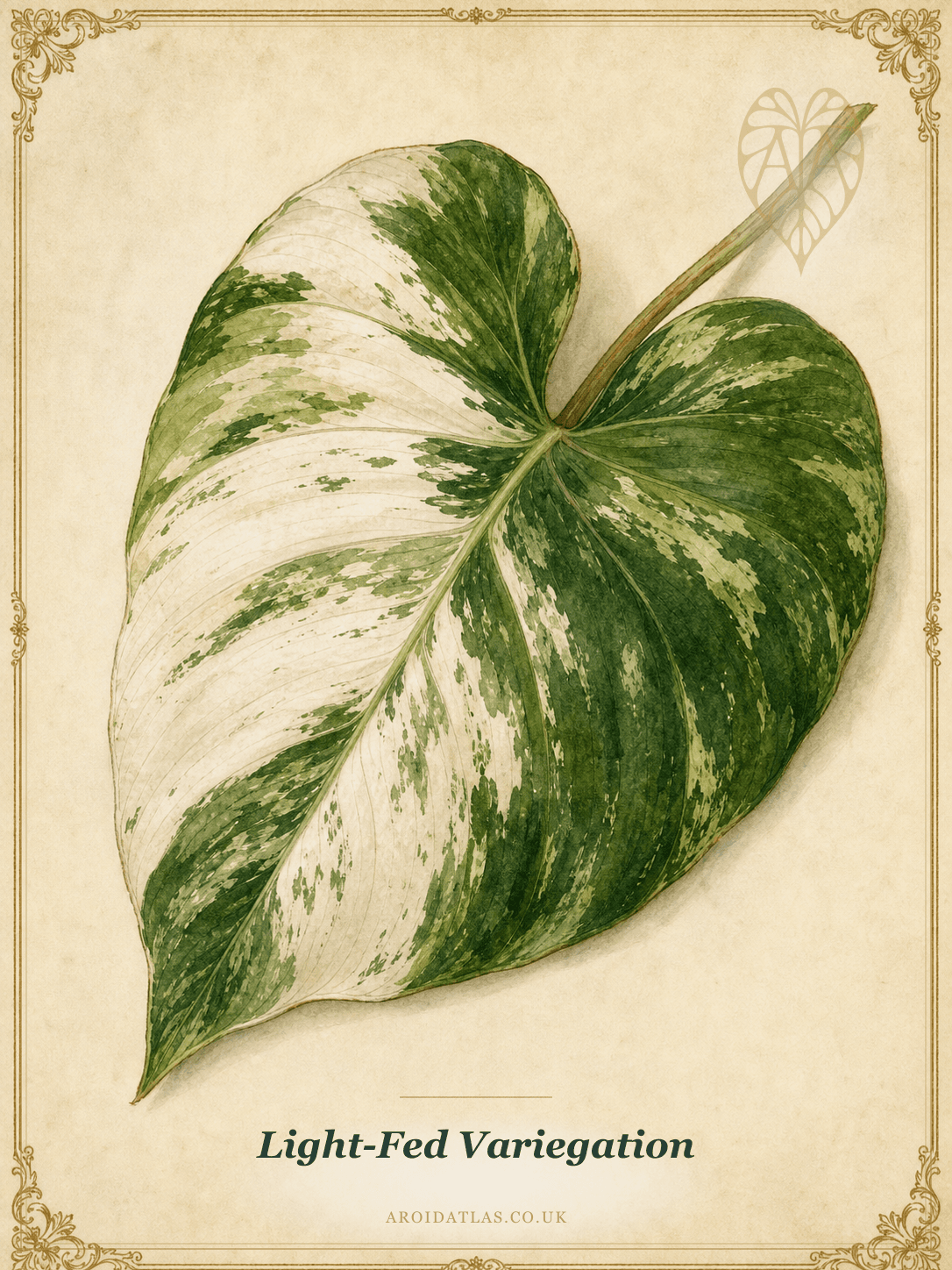
Light-Fed Variegation
Variegated sectors carry little chlorophyll, so the remaining green tissue works harder under strong light to support the whole leaf. A well-lit plant holds its pattern; an under-lit one gradually reverts to green.
Reading PPFD instead of guessing
Photosynthetic Photon Flux Density (PPFD), measured in µmol/m²/s, is the actual usable light hitting a leaf surface, a far more reliable measure than 'bright' or 'dim' by eye, since the human eye adapts to ambient light and consistently overestimates how dark a room really is. Most collectible aroids grow well in the 100-200 µmol/m²/s range for extended periods, with brief peaks tolerable up to around 300 for sun-hardened specimens.
A basic PPFD meter or a light-metering phone app removes the guesswork entirely. Take a reading at the exact spot the plant's canopy sits, not at the windowsill: light intensity falls off sharply with distance from a window, often halving every 30-40cm moved back into the room.
Variegation and grow lights
Variegated sectors of a leaf contain little or no chlorophyll, meaning the green tissue on that same leaf is doing the photosynthetic work for the whole leaf area. Variegated plants therefore generally need light levels toward the upper end of the range, or they respond by pushing new growth with less white or yellow patterning; a plant that seems to be 'reverting' is very often simply under-lit rather than genetically unstable.
Where natural light isn't sufficient, a full-spectrum LED grow light run for 12-14 hours a day is a dependable substitute, positioned close enough to deliver 100-200 µmol/m²/s at leaf height. A cheap timer removes the daily maintenance and keeps the photoperiod consistent, which matters more to steady growth than most people expect.
A phone can stand in for a meter
Dedicated PPFD meters aren't cheap, so most people start with a camera-based light-metering app instead. Photone is the one that comes up most often in plant-collector circles, and it's free to use. Treat the number as a ballpark rather than a lab-grade reading; accuracy varies by phone model.
Lux and PPFD aren't the same thing
A lux reading measures light the way the human eye perceives it, not the wavelengths a plant actually uses for photosynthesis. Some growers divide a lux reading by a rough factor (commonly somewhere in the 50-80 range under LED grow lights) to estimate PPFD, but that conversion shifts with the light's spectrum, so it's only ever a starting estimate, not a substitute for a proper PAR reading.
Quantum boards vs. spotlight LEDs
For a dedicated shelf, an even 'quantum board' panel (many small diodes spread across a flat surface) is generally preferred over an older single high-power spotlight LED. It spreads light more evenly across the whole shelf and runs cooler, which matters if plants end up sitting close to the fixture.
Rotate the pot
A plant left facing the same direction toward a single light source for months will visibly lean and grow lopsided. A quarter-turn every week or two keeps growth even without the plant ever needing to 'catch up' on one side.
Related Species
This guide applies directly to the following genera in our archive: