Humidity vs. Air Circulation
High humidity keeps growth points moist and helps aerial roots attach. However, stagnant air invites fungal pathogens. Active ventilation is key.
Why humidity matters more at the growth point
A new leaf emerging from an aroid's growth point is thin, unlignified, and almost entirely water by weight. It has none of the protective cuticle a mature leaf has developed. In a dry room, that emerging leaf loses water faster than the plant's roots can replace it, and it either stalls mid-unfurl or opens with crisped, torn edges. Most collectible aroids are happiest in the 65-85% relative humidity range, well above the 30-40% typical of a centrally heated home in winter.
Humidity is also functional for aerial roots. Species that root along the stem as they climb (most Philodendron and Monstera) use those roots to sense moisture in the surrounding air and substrate; in low humidity they stay dry, brittle, and largely non-functional, contributing nothing to the plant's water or nutrient uptake even when physically present.
Step by Step
Follow the trail below, one component at a time — each illustrated in the same antique botanical plate style used across our species archive.

Hygrometer
A simple hygrometer turns humidity from a guess into a number, letting you confirm a grow space is actually holding the 65-85% relative humidity most collectible aroids prefer rather than assuming it from a misted leaf.
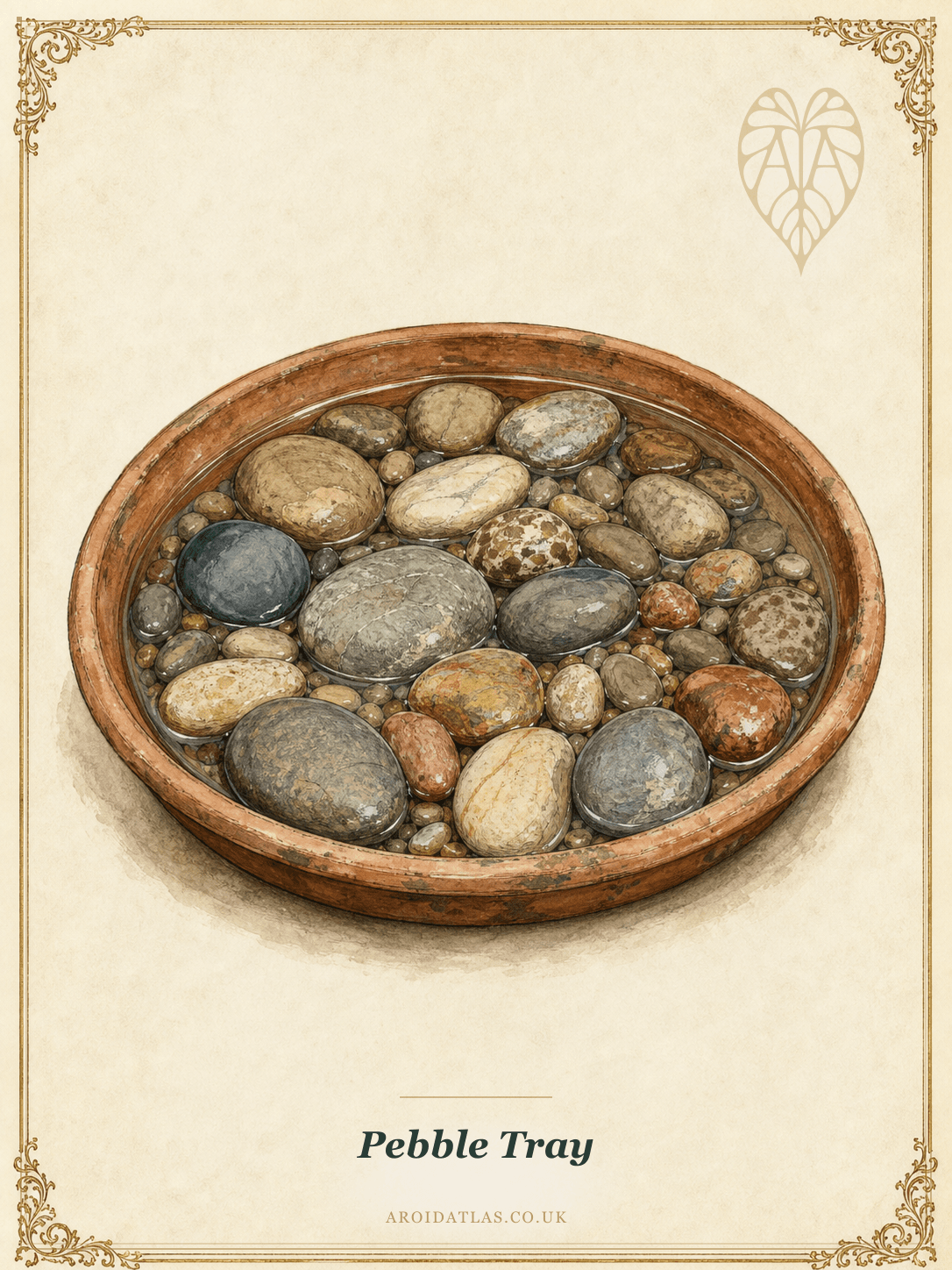
Pebble Tray
A shallow tray of water topped with stones raises local humidity around a pot without waterlogging the roots, since the plant sits above the waterline rather than in it.
Top up the tray before the water level drops below the stones, or you'll waterlog the very roots you're trying to protect.
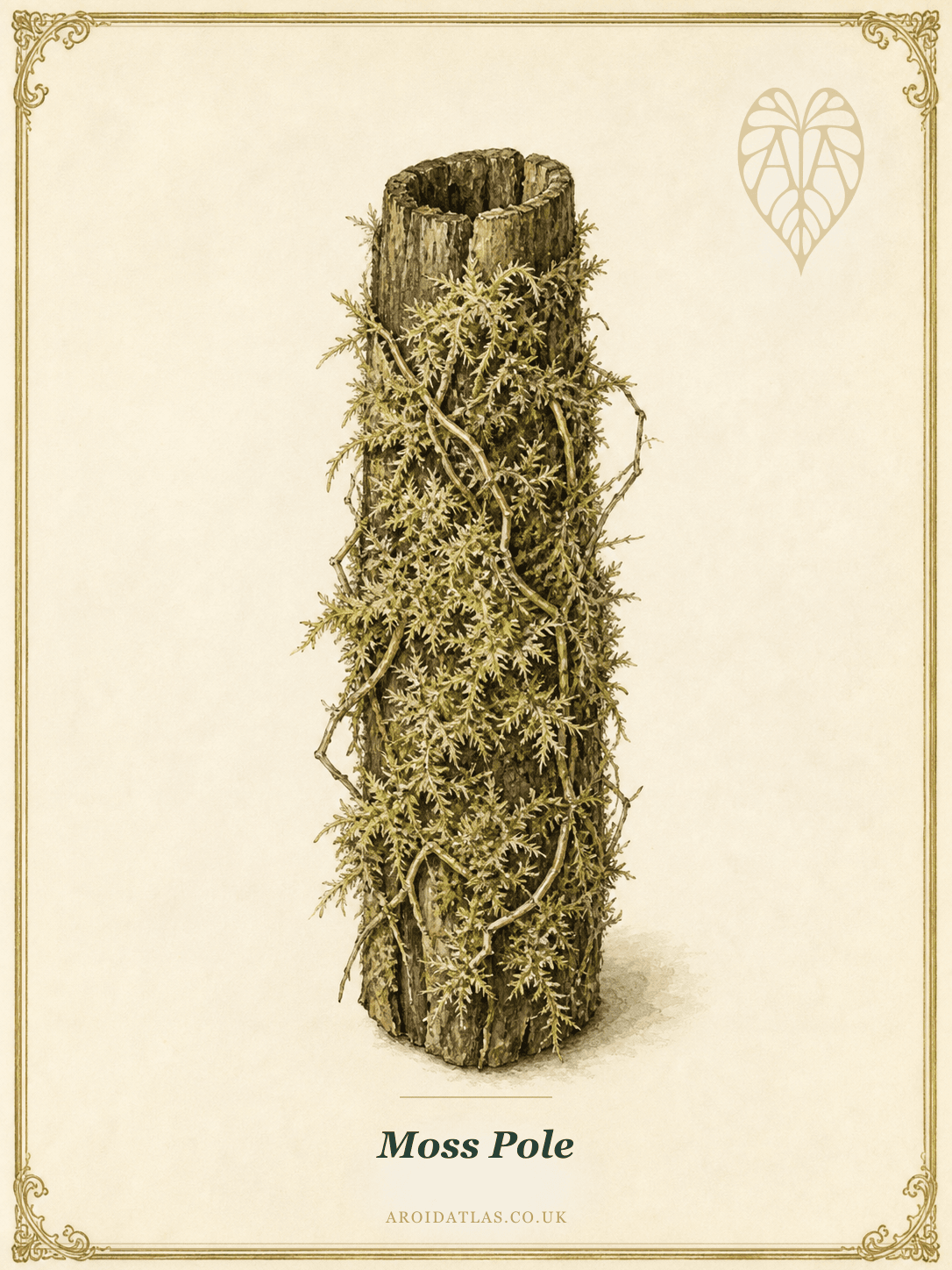
Moss Pole
Kept consistently damp, a sphagnum-wrapped support pole gives a climbing stem's aerial roots something to grip and hydrate from, which in most climbing aroids drives larger, more mature-form leaves further up the plant.
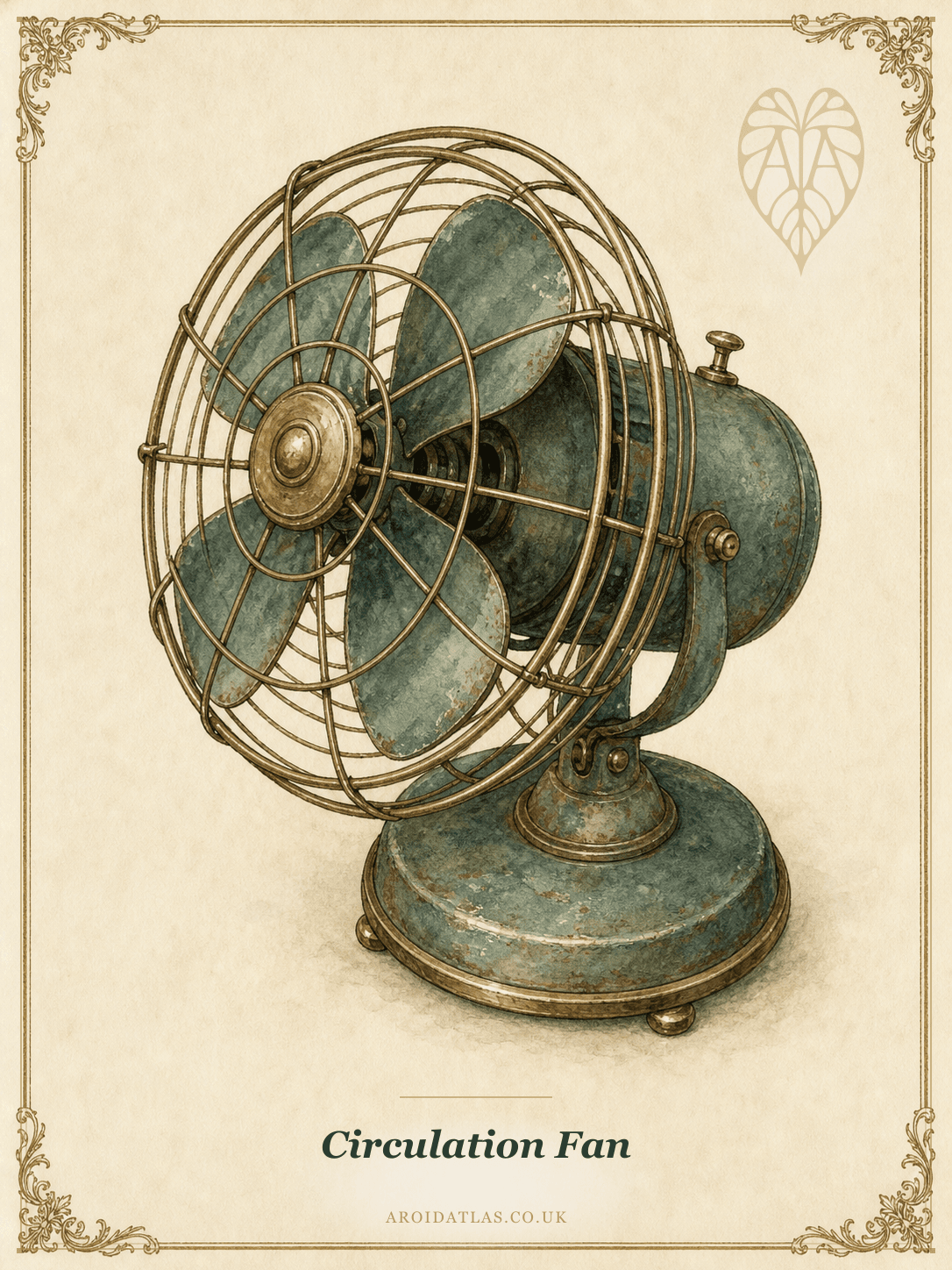
Circulation Fan
A small, low-speed fan keeps air moving gently across leaf surfaces inside a humid space, preventing the stagnant, still conditions that fungal and bacterial pathogens favour without stripping away the surrounding humidity.
If leaves are swaying, the fan's too strong. You're aiming for a whisper of movement, not a gale.
The airflow trade-off
Humidity alone isn't the goal; stagnant humid air is actually worse for a plant than moderate humidity with good circulation, because it's the exact condition fungal and bacterial pathogens thrive in. A sealed, unventilated grow cabinet running at 90% humidity with no air movement is a well-documented recipe for leaf spot and stem rot, particularly on thin-leaved, high-humidity species like Anthurium.
A small, low-speed oscillating fan running continuously (or on a timer for a few hours a day) inside a humid enclosure keeps air moving across leaf surfaces without stripping the surrounding humidity. The fan should be felt as a gentle breeze on the back of the hand, not a directed blast that dries the nearest leaves faster than the rest.
Practical humidity sources
A humidifier is the most controllable option for a dedicated grow space, ideally paired with a hygrometer and humidistat so it runs only when needed rather than constantly. Pebble trays (a shallow layer of water with pots sitting above the waterline on stones) offer a gentler, more localised boost useful for a single plant on an open shelf, though the effect is modest compared with a humidifier in an enclosed space.
Moss poles serve a similar dual purpose to sphagnum in the substrate: kept consistently damp, they give aerial roots something to grip and hydrate from as a climbing stem grows, which in most climbing aroids correlates directly with larger, more mature-form leaves further up the plant.
Calibrate your hygrometer before you trust it
Cheap hygrometers are notoriously inconsistent out of the box. The standard fix: seal ordinary table salt, dampened with a few drops of water, in a bag with the sensor and leave it for 5-6 hours. A working unit should settle close to 75% RH; if yours reads a long way off, you now know to mentally adjust every reading it gives you from then on.
Misting is mostly theatre
A quick spray briefly bumps the humidity right around a leaf, but that boost is usually gone within minutes as it evaporates. It doesn't meaningfully raise a room's ambient humidity. It also leaves water sitting on the foliage, which is more likely to cause spotting on sensitive genera than it is to actually help.
Pebble trays are the weakest tool in the kit
They're cheap and popular for exactly that reason, but the humidity boost is small and stays close to the tray. Fine as a minor supplement next to a more humidity-hungry pot, but don't expect one to do the job of a humidifier or an enclosed space.
The IKEA cabinet hack
Glass-doored display cabinets (the Milsbo and Fabrikör ranges get mentioned constantly in aroid-collector circles) are a popular budget way to build a small, enclosed, humidity-stable space without committing to a full grow tent.
Related Species
This guide applies directly to the following genera in our archive: